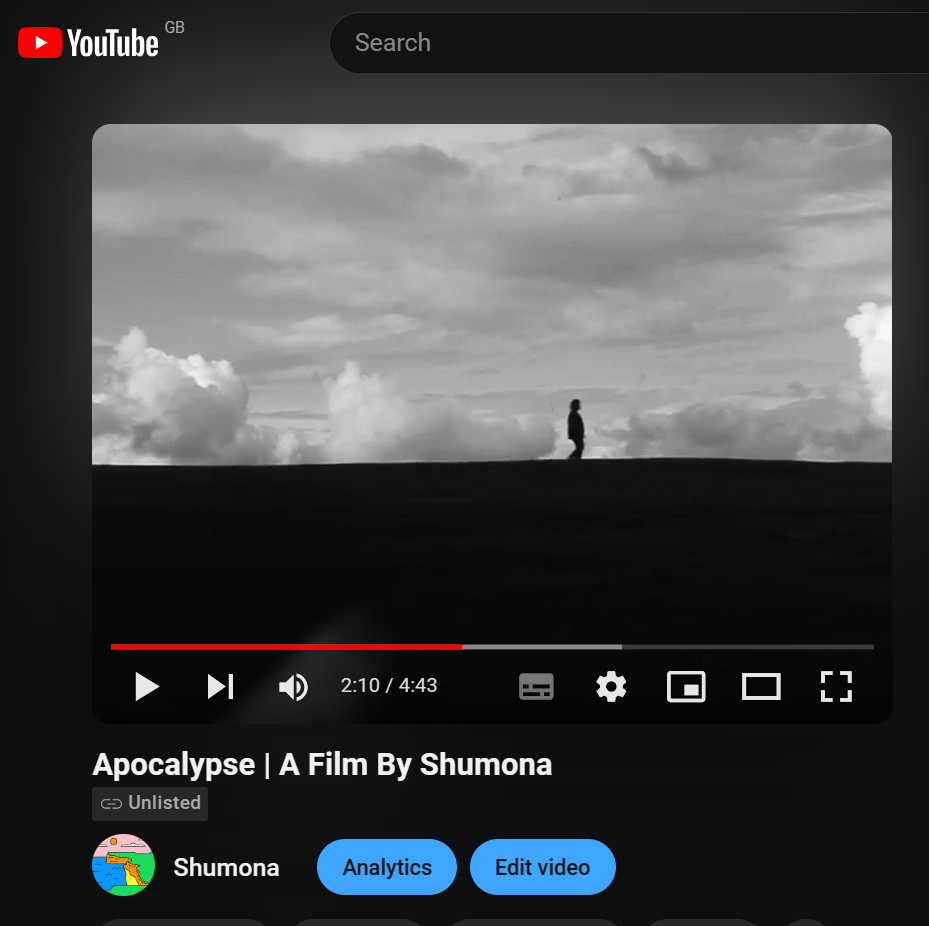
This short film was the first one I made for my college project. I put it on youtube as a place to see it and it is completely finished and edited. The film itself was one of my fist official projects that I would be graded on. I came up with the story myself, wrote the script and filmed all scenes with my canon 500d. I was very happy with the end product because I did everything I wanted to do. I was able to get good cinematography, able to shoot enough scenes, and finish editing before the deadline. This project was exciting and fun for me because I could do whatever I wanted with it. i could choose my story, decide what would be in my film and could use my imagination.
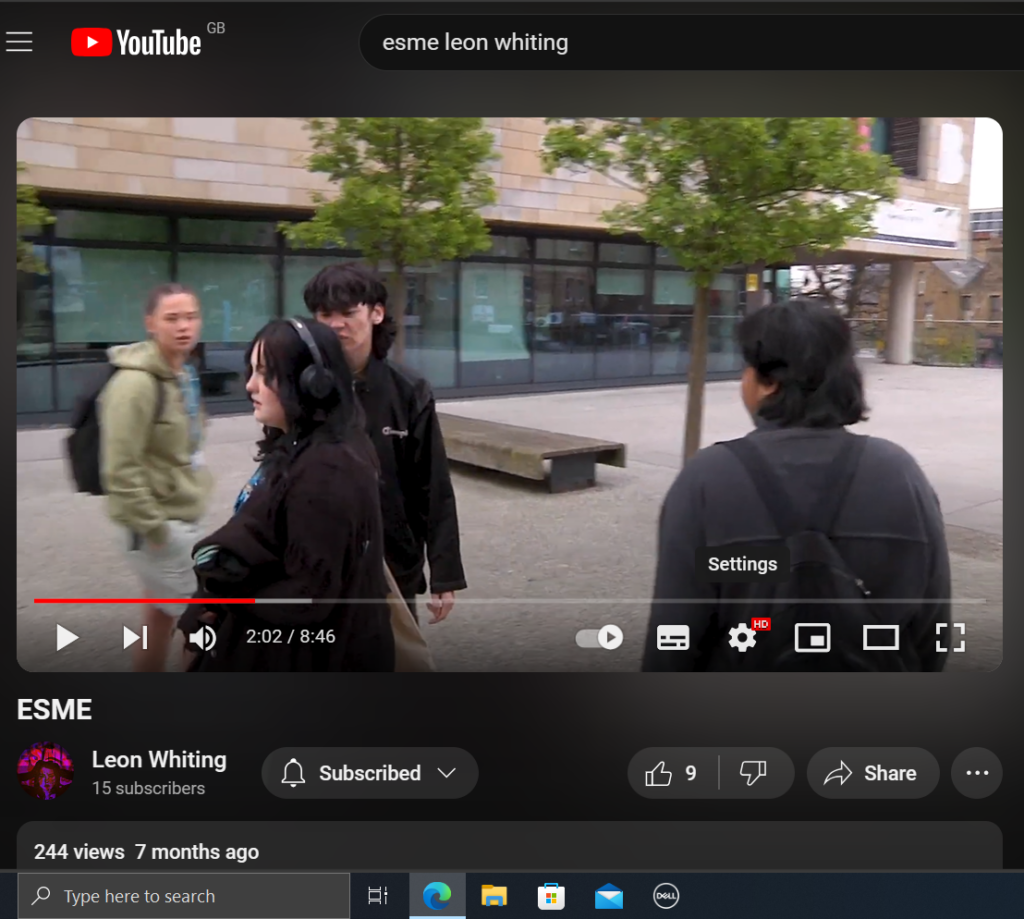
This is one of my classmates films where I played an extra. I was in the film for about 3 minutes and I wanted to help out and play one of the ‘bullies’. I find it fun to be a part of other films and see how other people’s creative imaginations work. It’s inspiring for me, and to see how they work helps me with my work too.
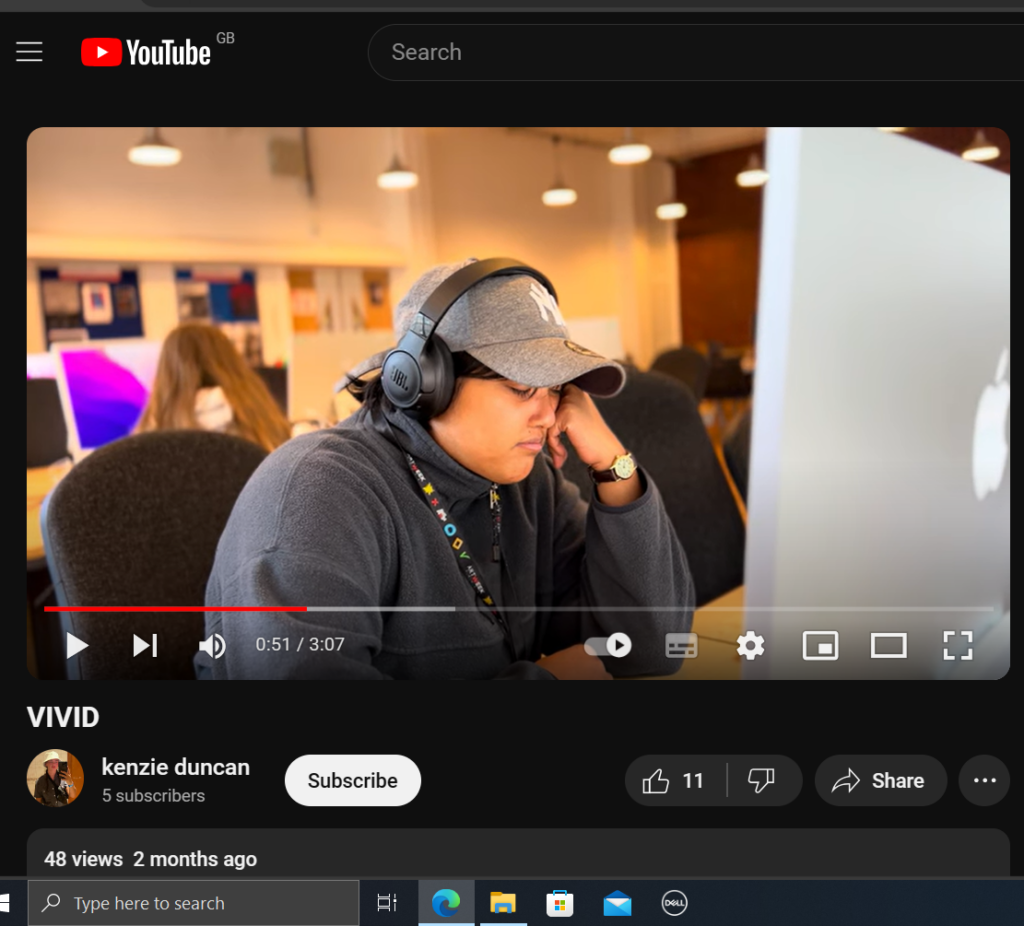
This film was also my classmates project. In this short film I am the main character and I wanted to take on this role so I could see how actors work around a camera and how it feels to be in front of the camera for once. I normally like directing myself, and working out the angles, where to shoot etc., but being in front of the camera gave me a whole new list of responsibilities and I realised how my perspective changed when acting. Now, when I am directing, or operating the camera I know how to talk to my actors and how to get the right shot.
When it comes to editing, I like to use Adobe Premiere Pro, or After Effects because they are the easiest for me to use and I think they are the best for editing video footage. When making a poster for a film or on any project in class, I like to use Adobe Photoshop and Adobe Illustrator. These apps are a good platform to edit and tweak your work. It was difficult to get the hang of first but once I started more projects and played around with the tools I learnt what they were and how I could use them correctly.
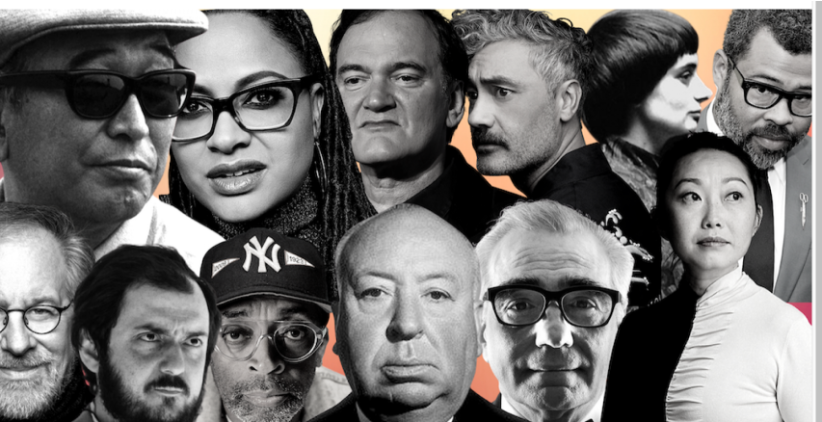
I will be looking at different horror directors to see how they film their movies. Some films I will be looking at is Zombie land, Bad taste, 28 days later and Shaun of the dead. I don’t know if I will make it a horror or a horror/comedy which is why I’m going to be looking at different styles of the same genre.
Most original zombie movies have a sub-genre. This makes it easier for them to stand out. If a film doesn’t have a purpose other than a bunch of zombies and humans killing each other, it can quickly become tiresome.
Having a genre sets the tone and atmosphere of the film so that the audience takes away from the film what the screenwriter intended.
Scripts, I. (2022). How Do You Write a Zombie Movie That’s ACTUALLY Original? [online] Industrial Scripts®. Available at: https://industrialscripts.com/zombie-movie/#h-4-flipping-the-script [Accessed 8 Mar. 2023].
My targets for the next month are:
To finish my script for the film
Loan out equipment so i’m prepared
Finish my research on topics related to my project
I also need to finish my idea list and have a strong story
I am thinking of doing a podcast for my final project. I want to talk about something I enjoy, so I might make the subject be video games, New Tv shows or upcoming films of 2023. If I choose any of these I will have to do a lot of research on the topic and provide real facts and information and make sure I am not talking about false informations. I would like it to be an informal podcast where I am ‘having a conversation’ with the person who is listening. I would like it to be factual whilst also going over theories, release dates, and news tat has come out about said subject.
I will make a new logo and have a podcast name that relates to the subject that I’ll be talking about. In my last podcast that I did (Task 3), I made the mistake of using an actual picture for my podcast, which resulted in lower marks for the final grade because it was at risk of a copyright claim. I won’t make the same mistake this time – I will make my own logo using Adobe Photoshop that hopefully will look better and is one of my own.
Because of the possibility of talking about video games and films I will use references from the articles that talk about these things and quote them so I am not taking away from their work. I need to do research that goes into depth of the subject I’ll be talking about, I need to look into audience statistics and know how to market my podcast for a particular audience group.
Why am I doing this project? Strengths skill, influences, previous projects/experience?
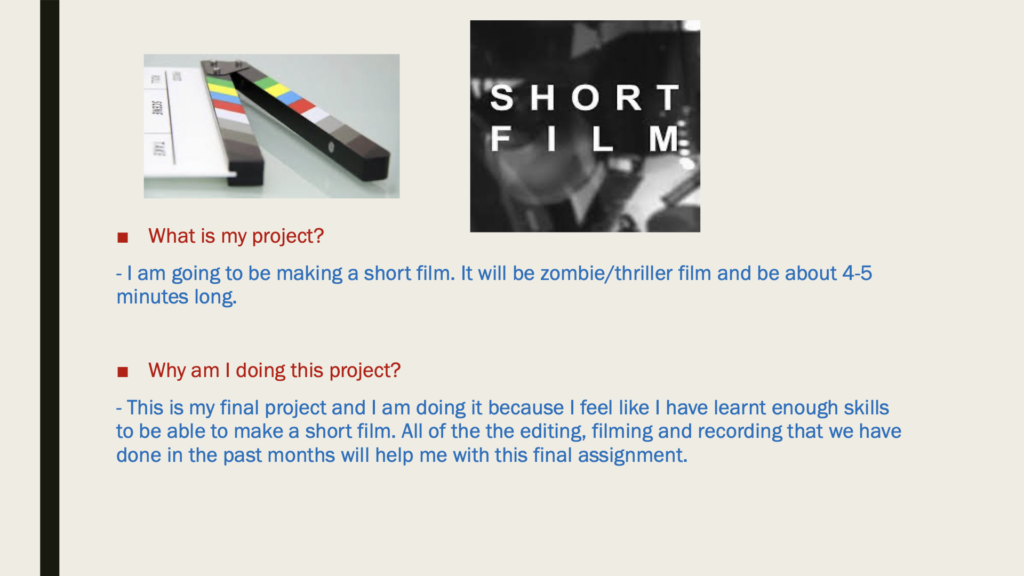
This is my final project and I am doing it because I feel like I have learnt enough skills to be able to make a full film. All of the the editing, filming and recording that we have done in the past months will help me with this project.
What is my project? Details
I am going to be making a short film. It will be zombie/thriller film and be about 4-5 minutes long.
Aim(s) (what) and Objectives (How)
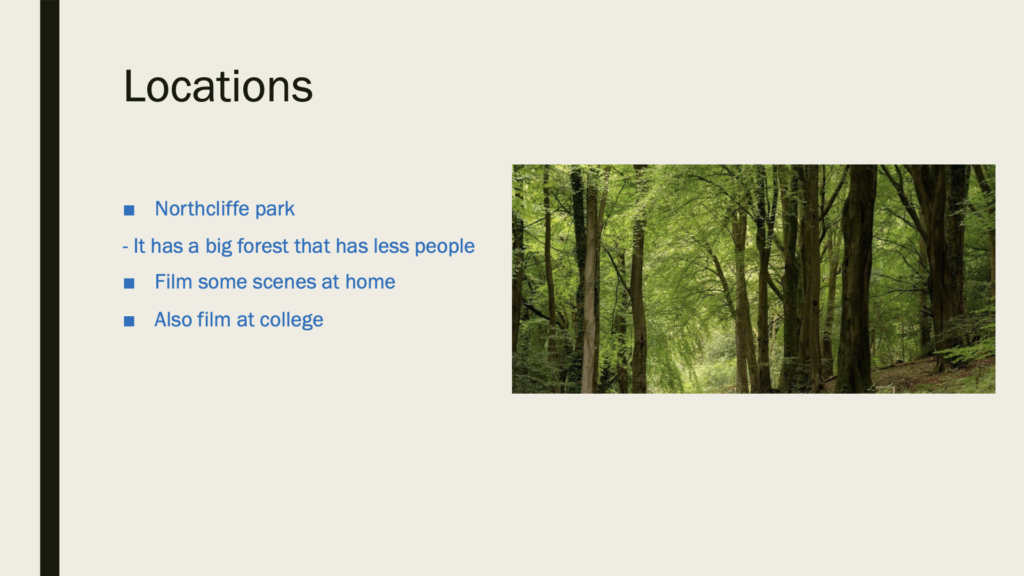
I will have a main character who will be on camera most of the time. One of my aims is to have a special effects person collaborate with me and have an actor wear zombie makeup. I have seen the masks that that the artists make and would like to have that in my film.
Target AudiencePersonnel/Resource List – who/what will you need to complete the project
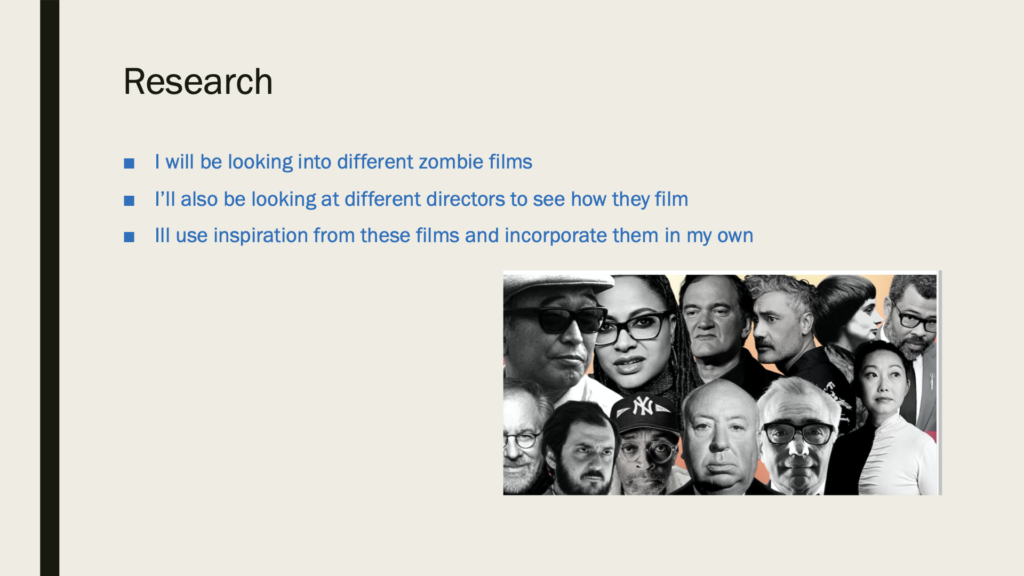
My target audience will be teen and up. This genre is for people who like apocalypse shows and films. I will need to make it accurate so I will research into other zombie films. I will look at different directors and behind the scenes to see how they film and what they do to make apocalypse films.
Collaborations – who will you be working with and what will their role be.
I would like to get an actor from the performing class. It doesn’t matter the gender as long as someone likes the role and is willing to travel to different locations. This is one problem that I have. I need someone who can travel. If i cannot find anyone I may have to be in the film myself or find a friend that I know who is willing to be in the film. I might get friends to be camera operators, or people who can help me with setting up the camera and light.
For a zombie character I would like to team up with make up artists to have a zombie mask. I’d like the mask details to be shown in the film.
🧟♂️🤫🌲🍂🔫🛣🔦
People said my presentation had good informative information about my project. I mostly got positive feedback and I got asked some questions at the end.
One question was ‘how does this relate to the community?’ Most of my answer was that I will be filming in areas around Bradford and I think people who live in Bradford will recognise this when they watch the film.
I got questions about the actors that I’d like to work with and how I will find a good person to play. (and if they are available)
If the performing arts actors are not available I will either find a friend who would like to play the part or play it myself.
I have already seen the zombie mask in the make up room so when i ask for it to be in my film I hope they will let me use it.
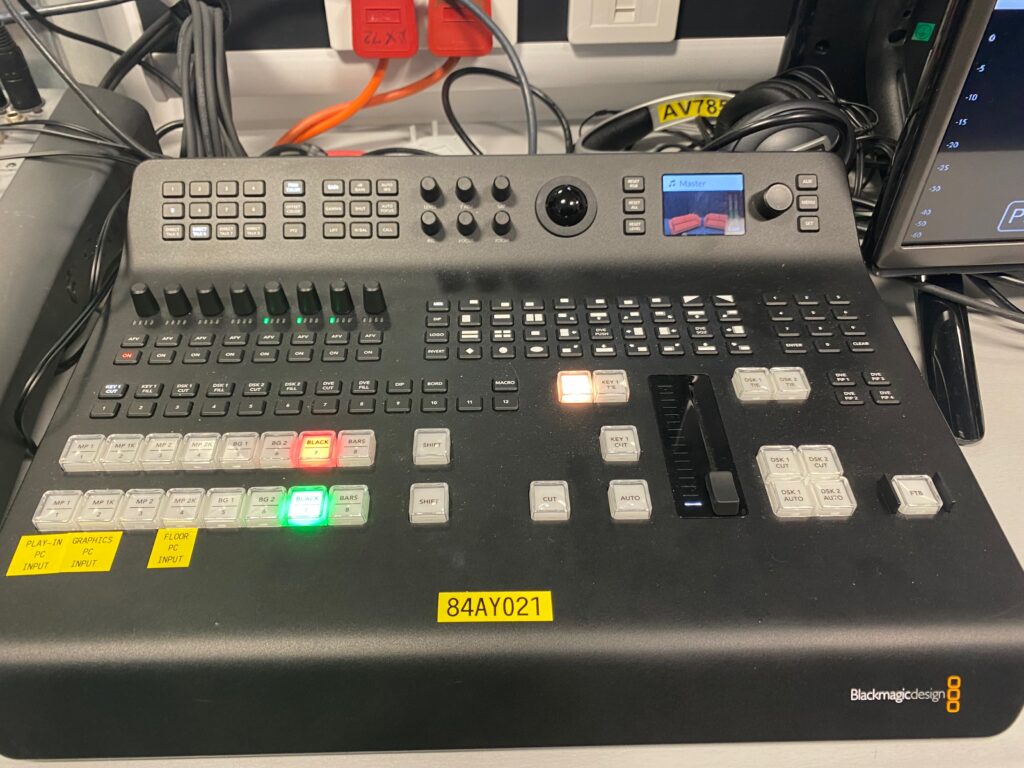
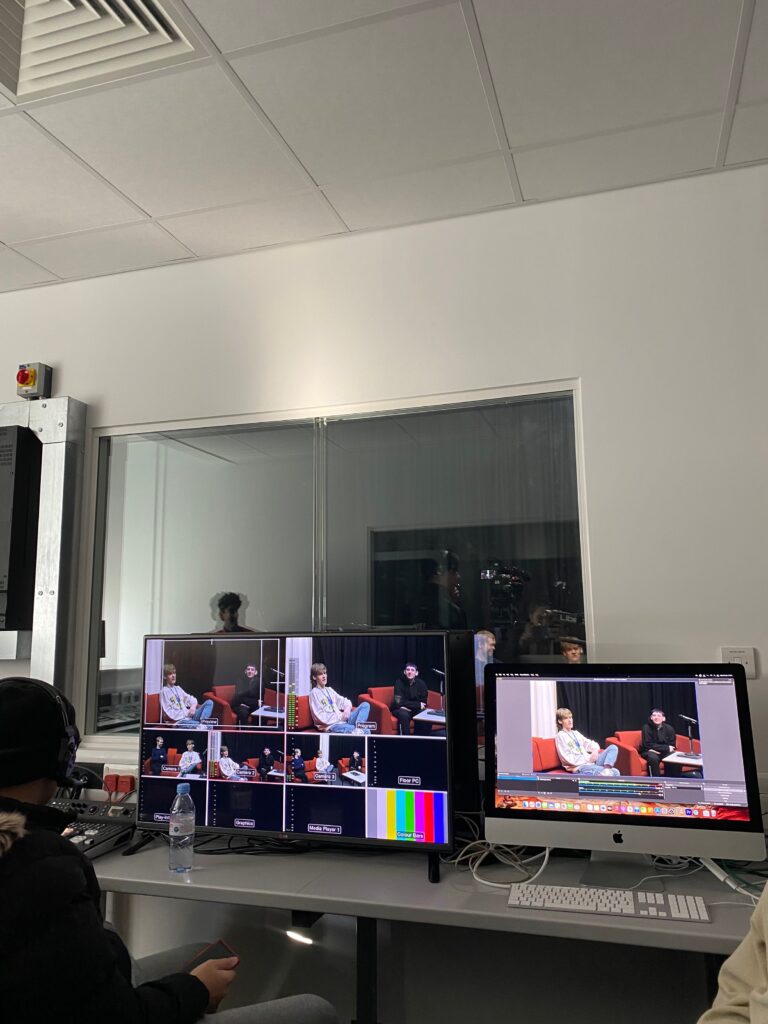
The machine I used is shown below. I understood how to use the preview and program when changing the camera. I also learnt how to use effects and how to fade to the cameras without switching it all the time. Even though we don’t want to add many effects we use a couple of fades throughout the show.
The fade to black (FTB) is something is use at the start of the show. When the director counts down I use this button to let the camera fade into our presenters of the show after the intro is played. The intro will be a maximum of 30 seconds, I then fade to black and whatever camera the director would like me to show i put on. The sliding black toggle is something I may use to switch cameras with a fade effect. This may be used a couple times throughout the show to switch things up instead of just going from camera to camera. When I use this slider I put the preview (the green buttons), to what camera the director would like it to fade to.
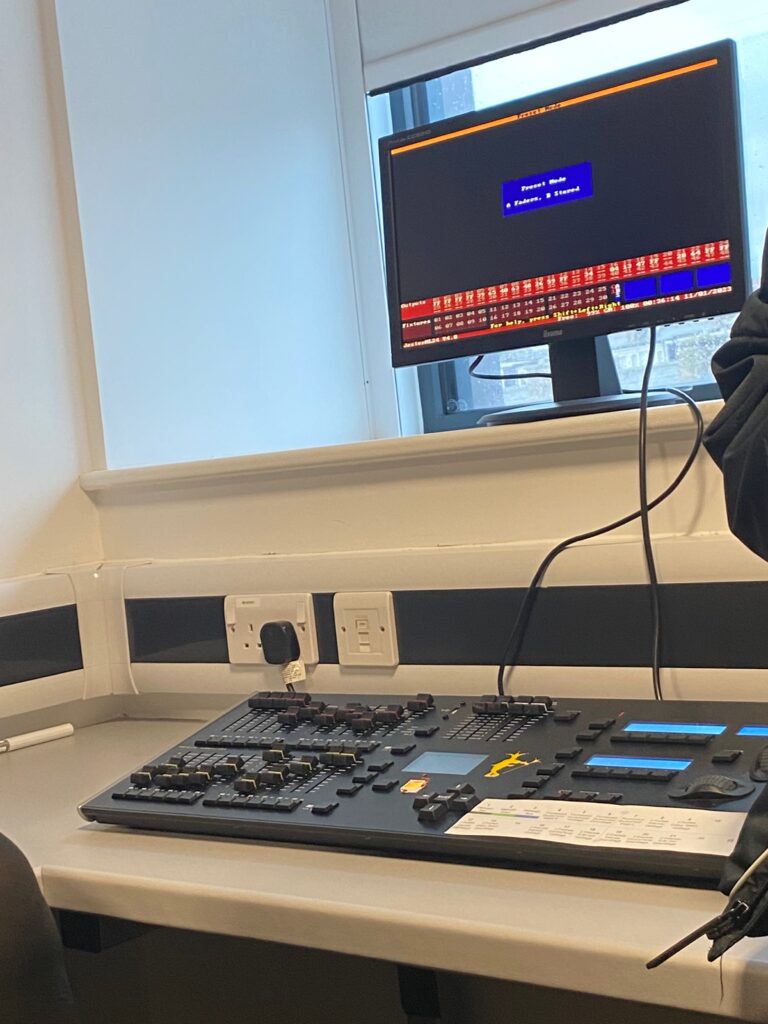
The lighting machine is also useful because we might want to have different colours or just set the tone of the show right with a specific colour. We may not use this but it’s good to have it here if we want to change the atmosphere. We may change the lighting for the entertainment part of the show to make the room seem more ambient.
I have looked at talk shows like Graham Norton and Jimmy Fallon where they have spotlights, they have mood lighting depending on the artist that is playing their music. We put purple lighting for the music performance towards the end of the show.
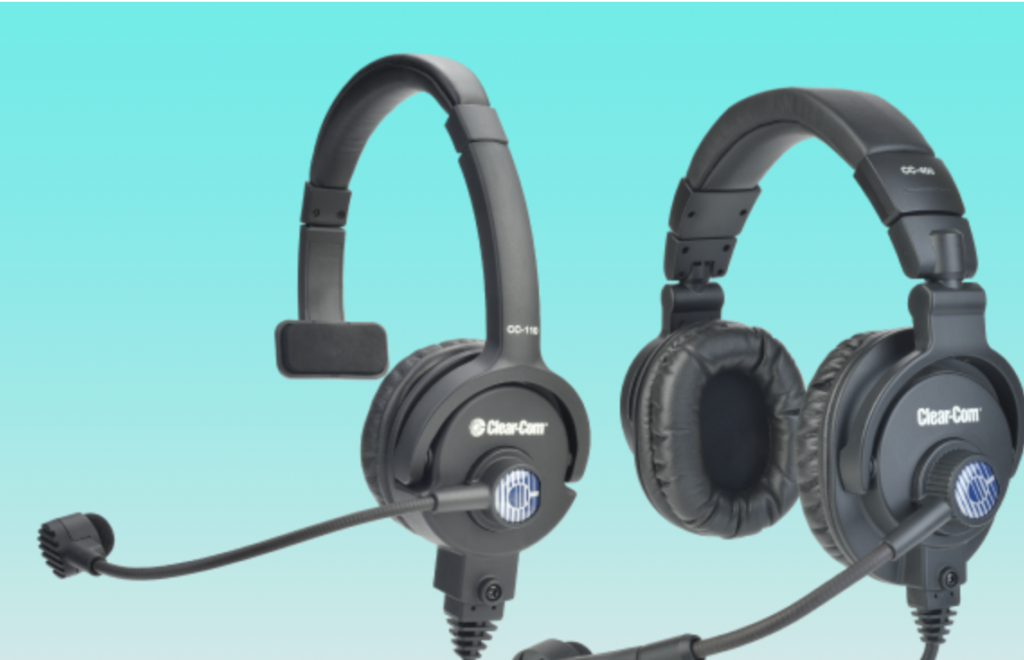
I didn’t take a picture of the wireless headsets that we use but they look very similar to these. These help the vision mixer (me), the director, (Kenzie) and the floor manager (Leon), communicate with each other easily without the hassle of moving rooms all the time.
What went well:
We managed to stay on track and follow our plan that we made. The presenters stuck to the script we wrote and switching from the studio to play-back videos went very smoothly. We managed to have a strong intro, that went to the studio, to the street interview and then back to the studio for the music performance. Our presenters said goodbye to the viewers and the whole recording was 24 minutes. Most tv shows are 20-30 minutes so we thought this was a normal length made for television.
I liked the music we chose and it fit the genre of the show well. Also, in the production room where me and Kenzie (vision mixer and director) stayed whilst filming – we managed to be organised enough to know when to switch cameras, and as the vision mixer I knew when to mute the presenters microphones when we went on to the play-back videos. I also had to unmute the music for the live performance towards the end of the show and it went very smoothly. I got instructions from the director on when to switch the cameras during filming, and what to preview when we wanted to fade to another camera.
Overall i have enjoyed this experience. I have loved seeing what we can add to the show to make it better, seeing our ideas come to life and being able to have control over what we would like to make. Our team has been great in communicating with each other and we all have found roles that suit us, we all take opinions from each other to see what we like and don’t like for our show.
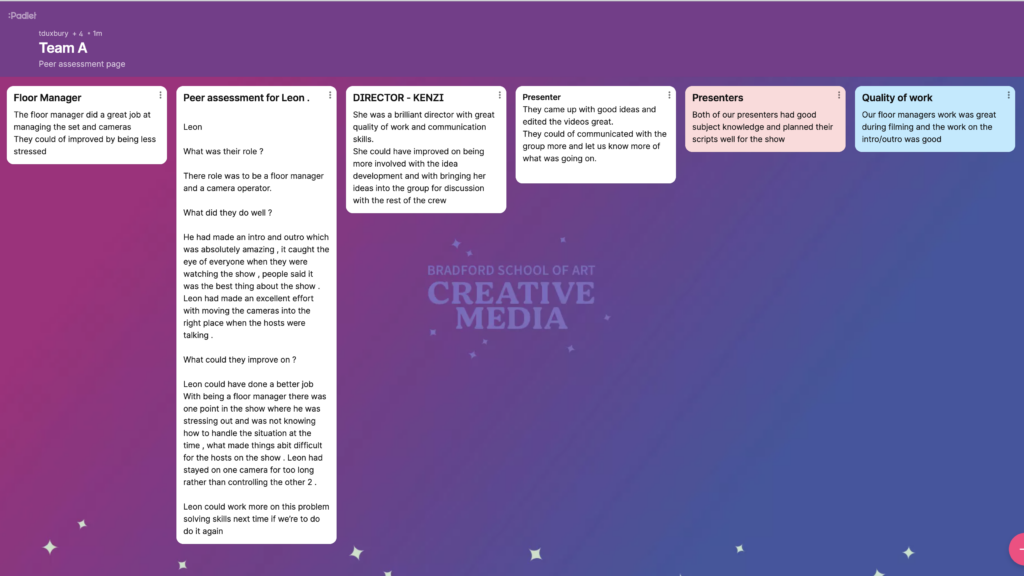
This is team A, and we have all assessed each other on what we thought was good and what we thought was bad. Leon our floor manager got a lot of positive feedback because of his quality of work and the effort he put into the filming room.
I put positive feedback for our presenters because they had good subject knowledge and their scripts we good they knew how to talk with the ‘audience’ and in front of the camera they were very interactive and knew how to present it as a tv show.
Our director Kenzie had great communication especially with me in the production room as a mixer and I knew what she wanted me to do during filming. Her quality of work was good and she brought up good ideas on what the presenters should do in the show.
I need to work on script writing and i should practice when given another project. My strengths during this project was being on time and organised when going from task to task. As a vision mixer I knew how to switch from camera to camera and I communicate well with out floor manager when filming. I knew how to mute our presenters microphones when we went to the play back videos and and when to unmute our music for the live performance towards the end of the show.
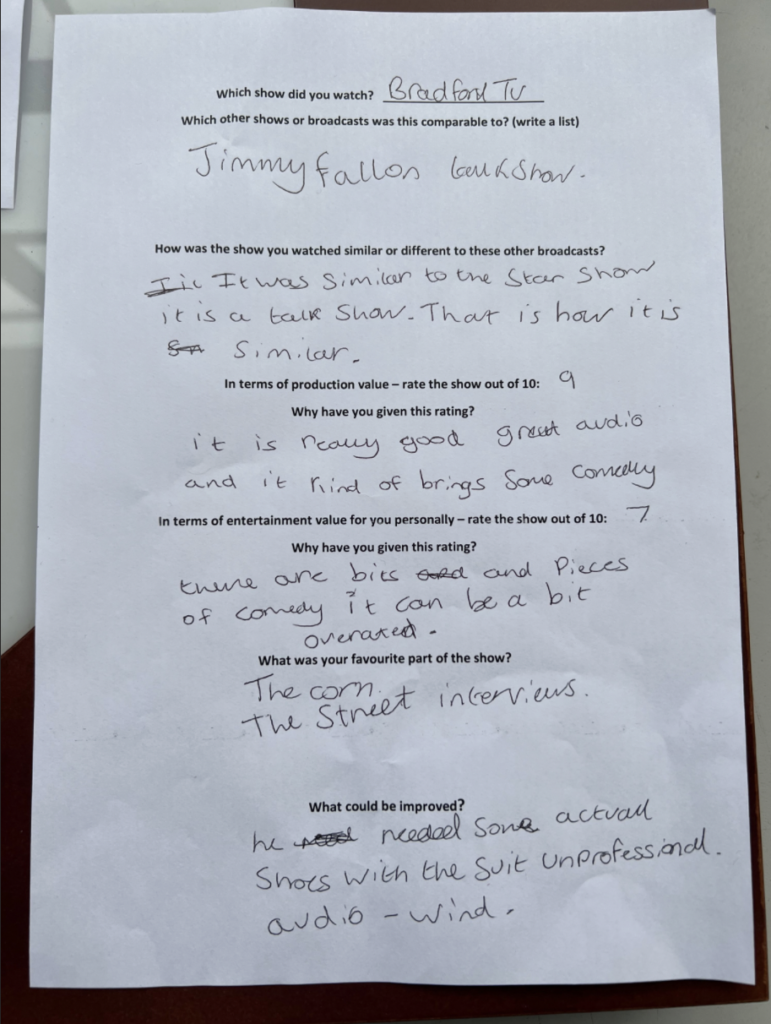
This was one of our feedback sheets from when we watched ur video with our classmates on 9th of February. They gave it a rating of seven out ten, which is a good score in my opinion. They liked our street interview which was our play-back videos that came on halfway through he show. However, there was also some negative feedback. They said our audio was bad due to the wind. This was most likely the street interview where we filmed outside in Bradford. The wind was bad during that time and we could film indoors and that was our only day to film. The audio was a bit choppy at times but it was okay for the rest.
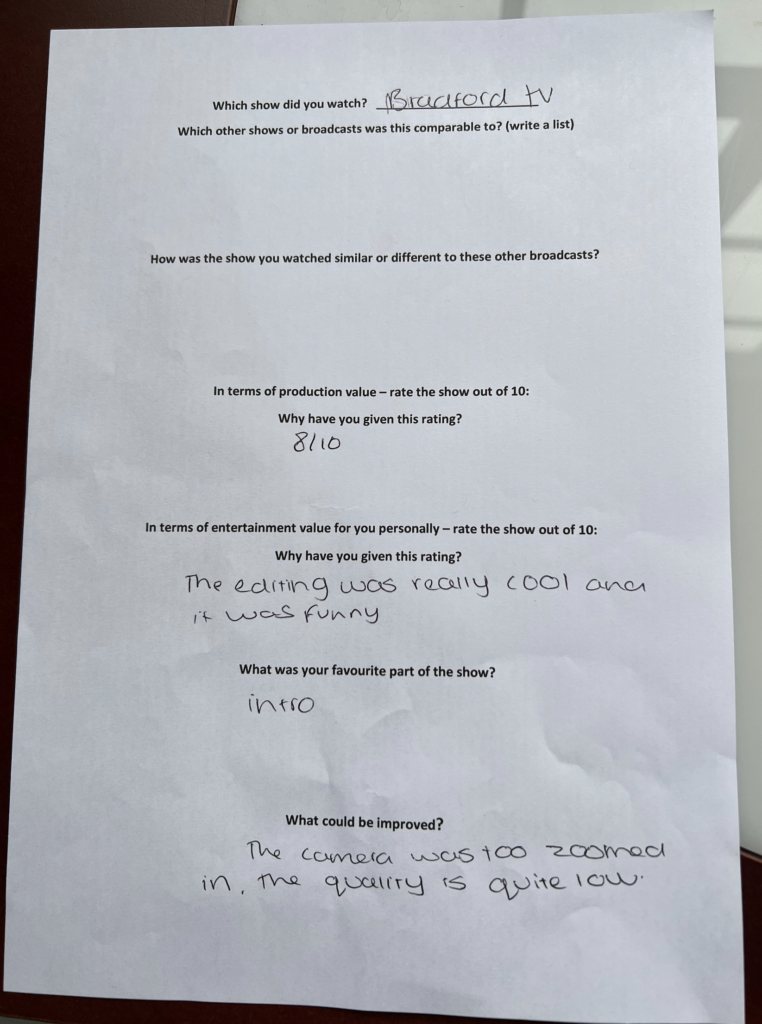
This person gave us an eight out of ten. They said the editing was really cool and it was funny. Their favourite part of the show was the intro and that is for Leon as he did the editing for it really well. However, there was some negative feedback and they said the camera was too zoomed in and that the quality was low. The camera was going from top quality to blurry at times when filming in the studio but we couldn’t. do anything to stop that. As for the camera being too zoomed in it may just be their opinion on how they’d like the show to be filmed because we were together as a group and agreed on certain camera angles and we liked the way we set it up.
This is our official talk show, it has been posted on YouTube as unlisted and it is around 24 minutes long.
I confirm that the attached assessment is all my own work and does not include any work completed by anyone other than myself and sources have been appropriately referenced.
The camera will pan to different presenters who will have a script and will know what to say in front of the viewers.
My groups main idea is to present a game show. Here we will have a main quiz where we question people on the entertainment industry. This includes questions about films, series and video games. We might do multiple choice, and our main editor will put in questions on the screen for the viewers to answer the questions at home. The questions will be about film and tv shows. It will be about things that have come out in the past year.
An example I have been inspired by is the UK game ‘The chase’. It has a main host, the players, and the person the players have to beat. I have chosen to get inspiration from the chase, because I like the layout, how they present the chase and it is something I want to incorporate into my show.
For research I have looked at shows like hot ones. This is a show where people eat and interview people. This is inspiration for our show and we will take aspects of this and incorporate it into segments of the episode. I have looked on youtube since that is where they release their interviews. Our show will be more tv based and not on social media sites. I have seen how they present their show for example, they have a host who invites a celebrity guest and they talk about the celebrities life and what they have done in their career. Their set up is nice and simple, it also similar to our set up. They have a main camera to show both people and another two that focusses on one of them separately.
I have also looked at good morning Britain. Their show is on itv, and itv hub. However you can also see clips of it on youtube. What I like most about good morning Britain is how they present their show. I like their intro music which is linked here. https://www.youtube.com/watch?v=m-byLeq8SqI (intro music for GMB)
What i also like about it is the graphics at the start. I’d like our show to have a strong intro, like this. We need to make a good logo that resonates with our show and the topics that we’ll be talking about. Our show will have fun parts but serious parts as well so I think the logo and how we present our show will be important.
My first idea has changed because we have now chosen our groups and we all have decided on an idea for the show. I have been looking at TikTok shows that people do, where they interview people on the street and we are using bits of that to incorporate in a segment of the show.
Looking at names for the show, we are trying to find a name that correlates to music and the culture of Bradford. We want something simple, clear and
As a group we have made a lot of decisions and are now making plans on how we are going to set out our show.
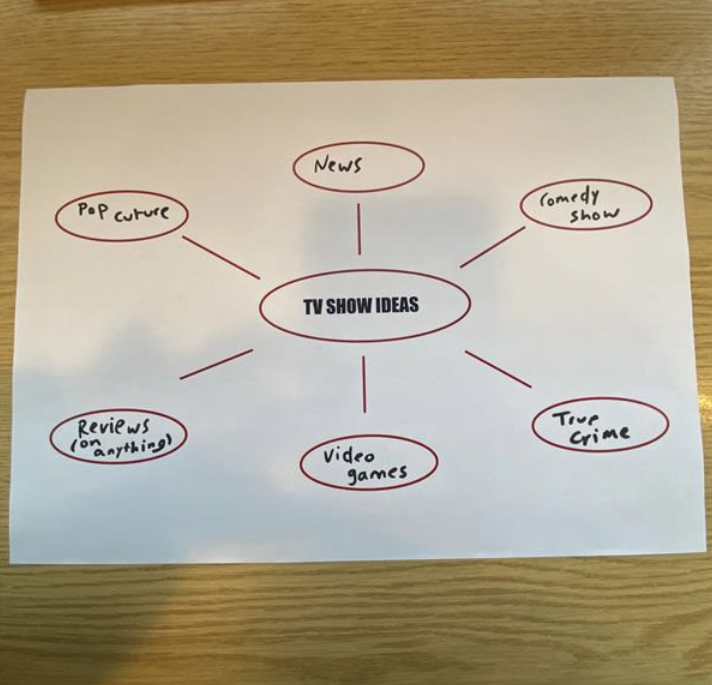
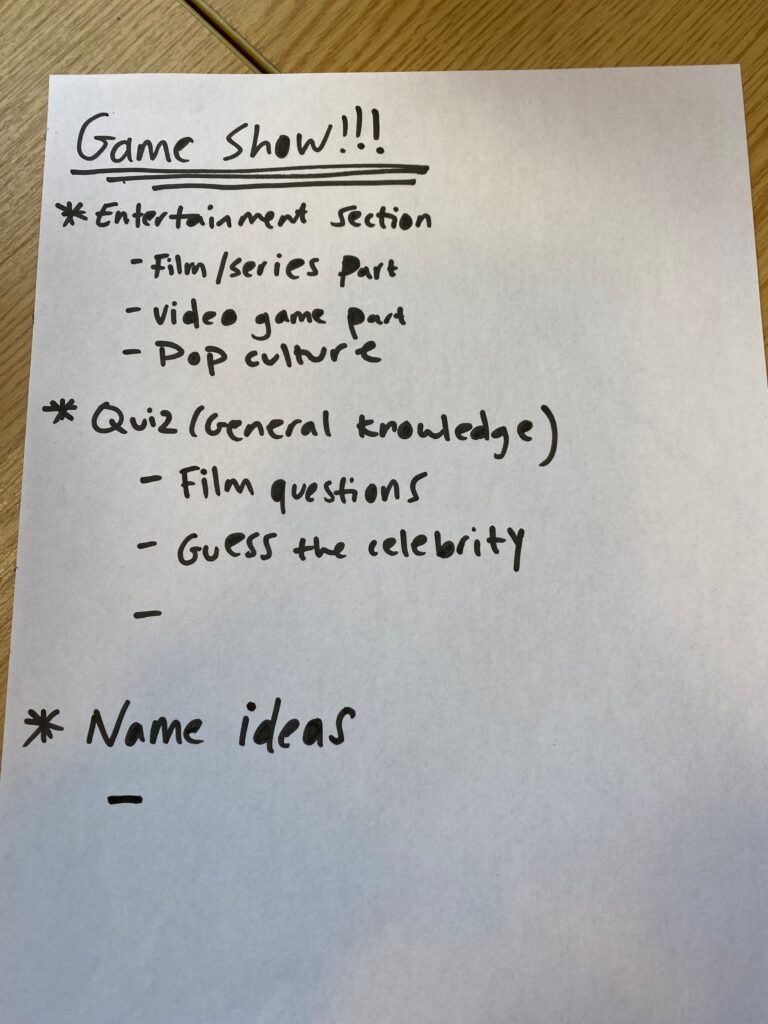
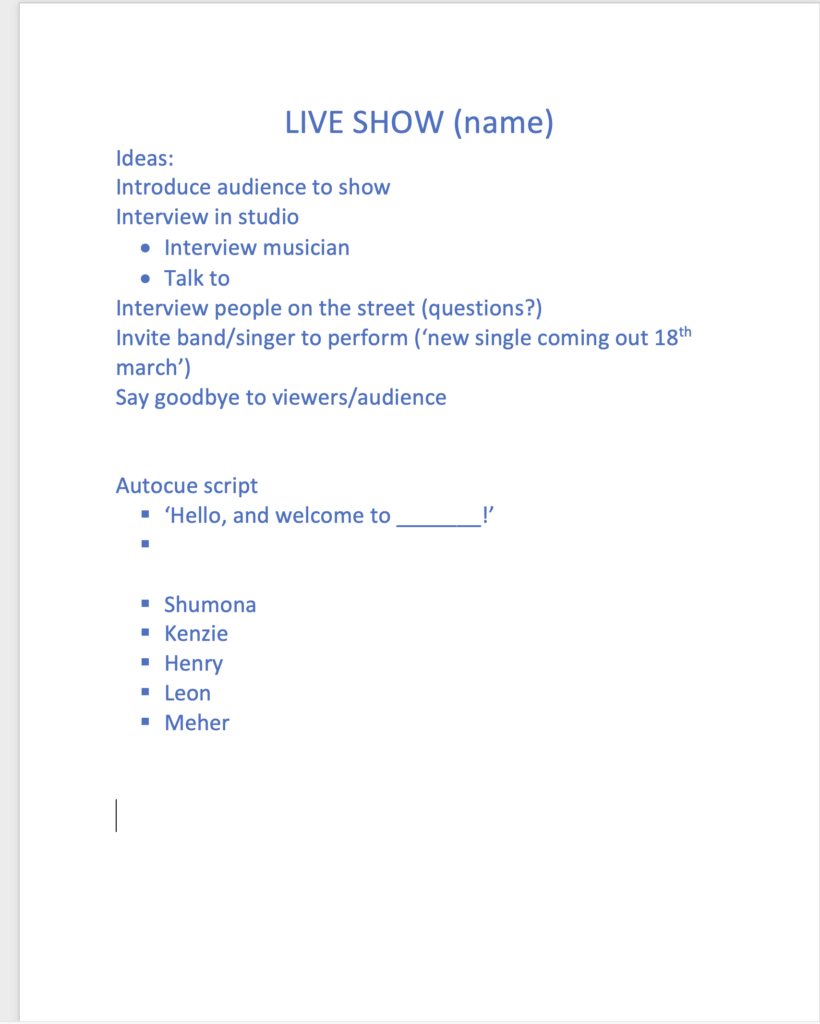
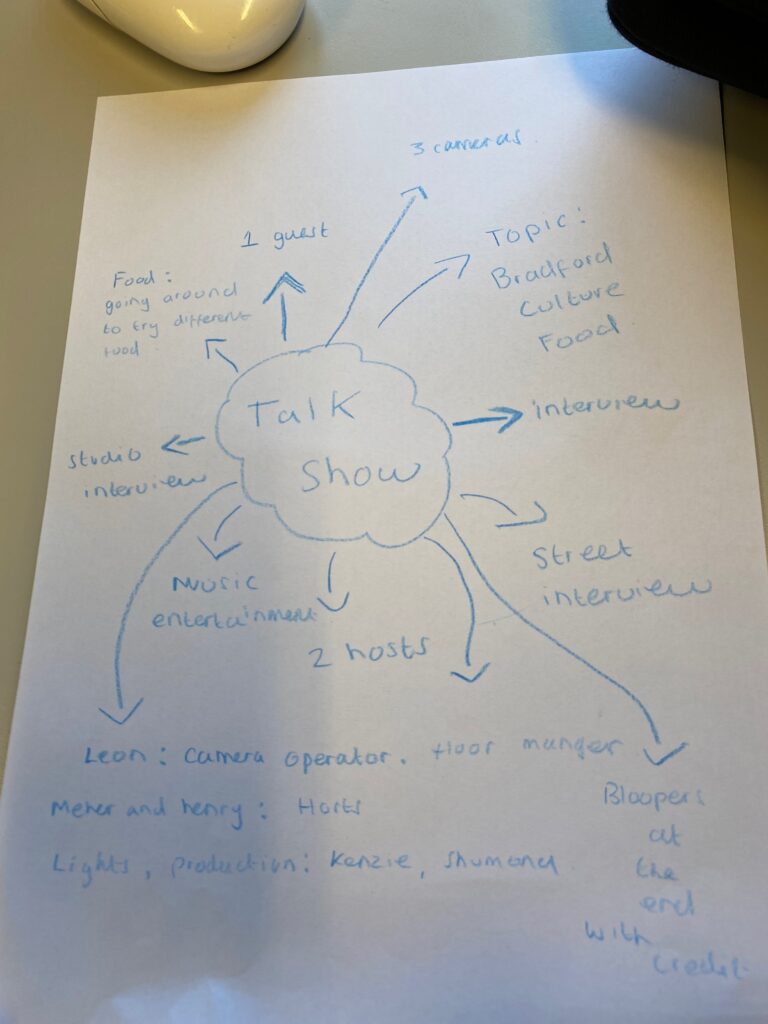
These are some ideas we wrote down on what we’d like our show to be like.
Our roles :
Shumona : Vision mixer/lighting technician
Kenzie: Director
Leon : Floor manager/editor
Meher and Henry : Interviewers
For the camera operators we may ask people to come in and help us out, but we have decided that we don’t really need to move the cameras during the show. We want the cameras to already be set up before we film, and me, the vision mixer will switch from cameras to ensure we get different angles so we can clearly see the presenters.
At the start of the show we are going to add some intro music. (We have not yet decided the music). This will play for approximately 10-15 seconds before our host will introduce the audience to the show. The interview will begin with our guest. Our main topic will be all about Bradford and the culture. We will have 3 cameras set up, and the camera operator will set them up so we can see the people in front of the camera clearly. The microphone will also be set up properly so we can hear them clearly.
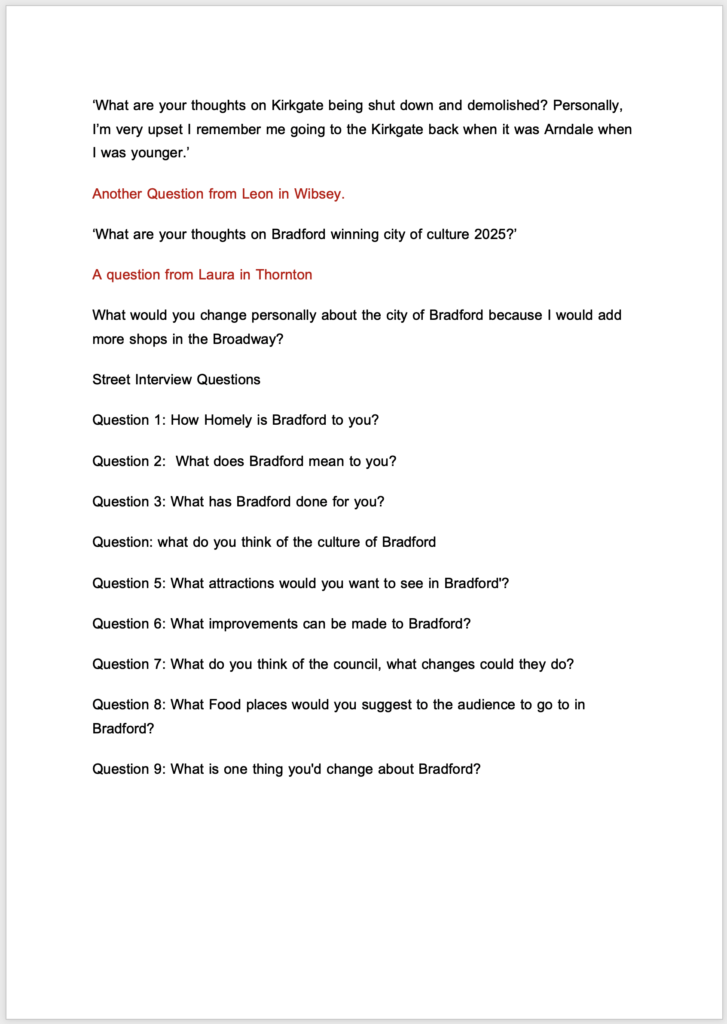
When we’re done with the interview part we might go to our next section of our show. This will be street interviews filmed by our main cast and crew. There will be our two presenters walking around Bradford, asking questions we would like to be answered.. We will set cameras up, or have a camera operator so we can film it without hassle.. It will be added to the show after we have recorded it and the sound effects and music will be edited in.
When the second section is done we will have the music and entertainment to finish off the show. This will be the closing act and our host will say goodbye to the audience, the outro music will play as the camera pans out and it fades to the credits.
For the credits I would like to add any bonus parts of the show that didn’t make it into the episode and add any bloopers that we have from filming. As our names go by with our roles on the credits the music will fade and the show will end. I would like the show to be 15-25 minutes long, however it depends on how much we can film. We also have to make sure that it’s not too long (30 minutes or more) and not too short 15 minutes or less). Most shows we see on television are 25 to 30 minutes long however there are also advertisements, so ours should run for 20 to 25 minutes.
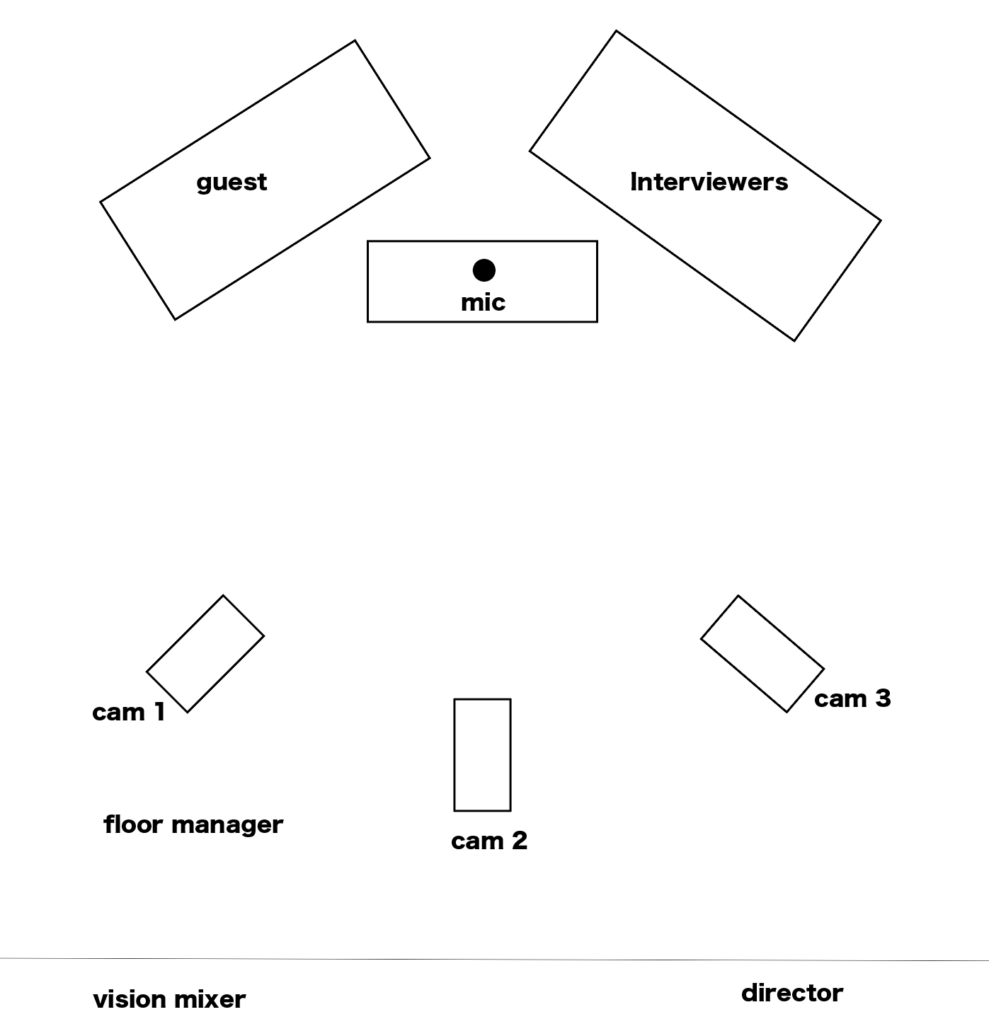
This is the set up i’d like in the studio. The vision mixer and director are of course behind the glass in the other room. The wireless headsets will help us communicate without the trouble of having to move rooms all the time. The cameras will be set up before we film,
Name ideas : ‘Bradford Live’ ‘Bradford TV’
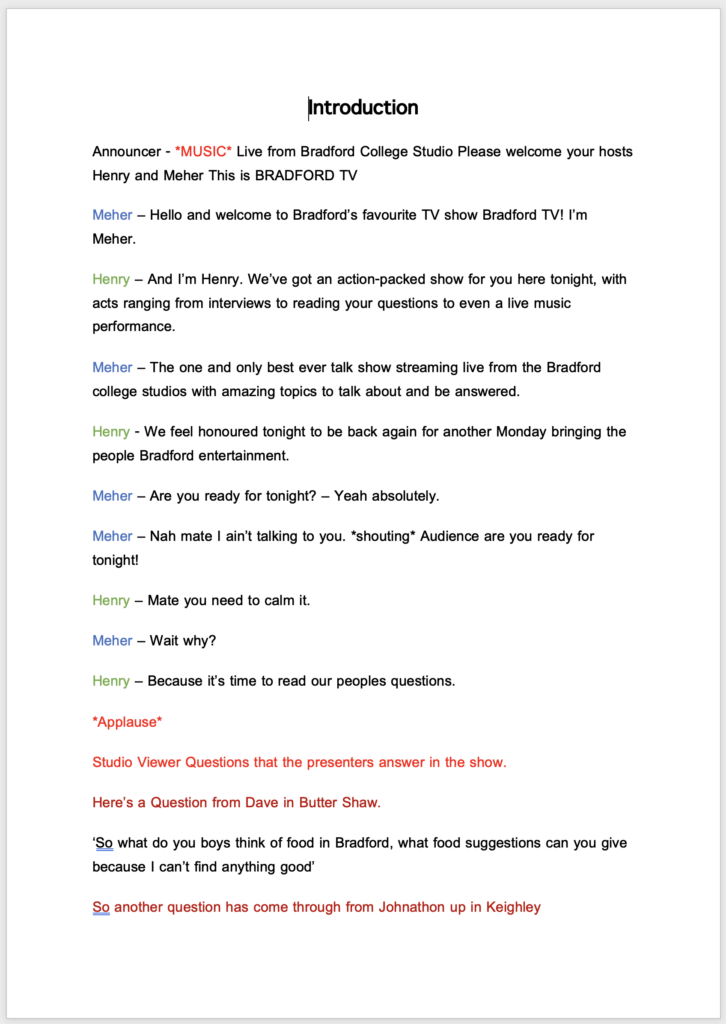
The script will be for the interviews in the TV studio. The interviewer will have questions to ask, approximately 4 to questions on the genre they will be talking about.
Today is 19th of January, we have planned where and what we are going to film. We have planned where the cameras will be, and how they will move in the intro and outro. We have decided on the music and entertainment. Which will be one of our main cast members performing his own music. We need to write a solid script and think of our music that we’ll use throughout the show. We all have our roles that we have for each other and we know what we need to focus on.
It’s 30th of January and we have finished rehearsals for our show. Everything went well and we all know what to do in our role. As a vision mixer i have tried and tested the machine i use to switch the camera. I now understand how to use it since trying it multiple times. The director is the person that helped me when rehearsing as they told me what cameras to switch to at the right time.
DATES FOR SHOW REHEARSALS
Monday the 30th of Jan at 9:30pm – 3pm
Wednesday the 1st of Feb 9:30 am – 4:30 pm
DATES FOR FINAL SHOW BROADCAST
Wednesday the 8th of Feb 9:30 am – 4:30 pm
These are the dates for the rehearsals and our team needs to book a slot so we can practice our script, how to test out microphones, cameras and for me the vision mixer i can play around with the technology to help me understand how we’d like the show to be presented.
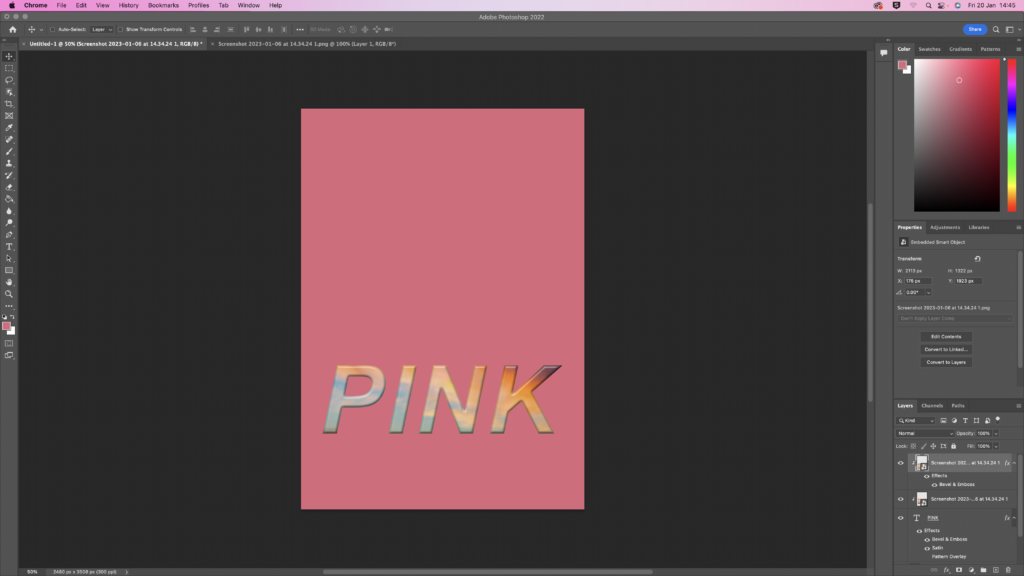
This is something i made to help me figure out tools on Adobe photoshop. This is something that helped when trying to make a logo that was good for our show.
Draft logo:
This is a simple logo that we might use in the intro and be used for branding and when people see our show.
The first logo below is without the Bradford logo because we might add a different background.
There are new logos that we all think is better and resonates with our show and Bradford. The second one is more colourful, has a better background and the font of the words have changed. This was made on photoshop, I like that it’s a lot more colourful, I like the microphone and television being incorporated into the title and it looks a lot more creative.
This is the first draft of the music for our intro. This was made by a member of our group and we all agreed that it sounds good and upbeat for the show.
Today is the first of February. We have filmed our street interview with Henry and Meher as the presenters. We had the cameraman hold the camera and microphone while trying to find people who will answer our question. The presenters also had cue cards to show what questions they want to ask. Finding people was difficult but in the end we got a good couple of interviews from people who wanted to be on camera.
It’s the 8th of February and the intro has been fully done. The same music is used and we’ve added Bradford in the back. Leon edited this as he is our main editor and he incorporated one of our presenters voices (Henry), towards the end to introduce our viewers. We will use this at the very start of the show as our intro.
We loaned out a camera and a microphone from the central media services, and it was used for the day. We had an SD card so we could get all the footage and later on edit it and put it into the show.
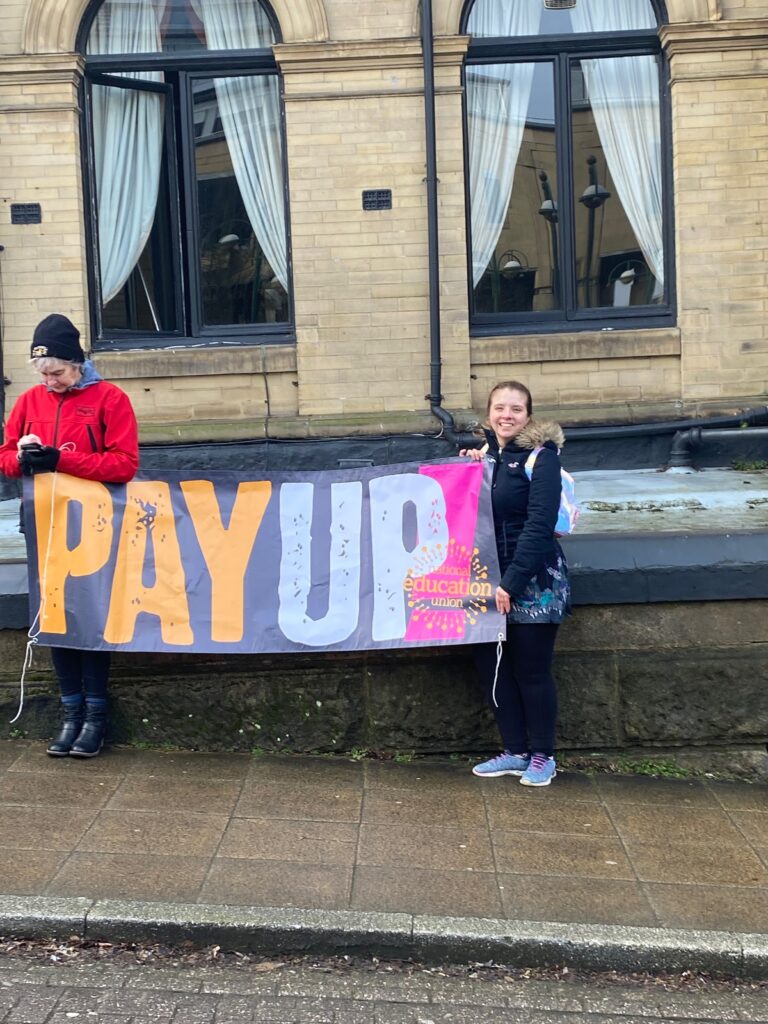
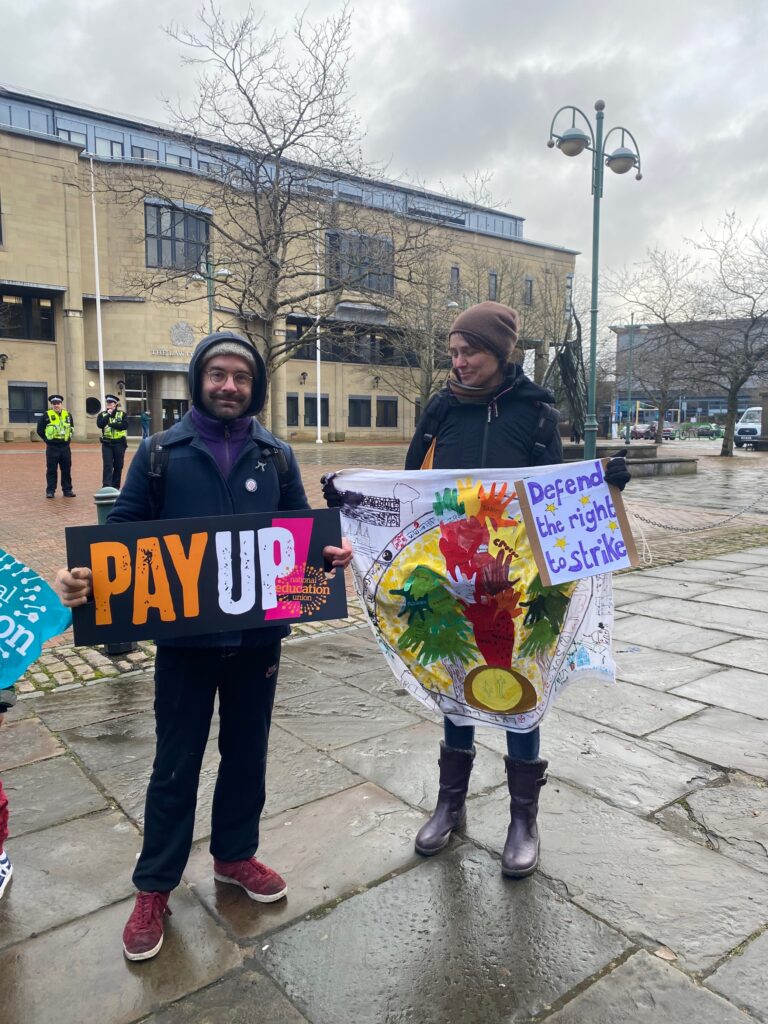
We also got the opportunity to find out about issues that have been going on in Bradford. There was a protest in city park (school strikes) and we got a couple of pictures of people with posters, and we managed to get an interview from someone. These are some protestors standing with their posters.
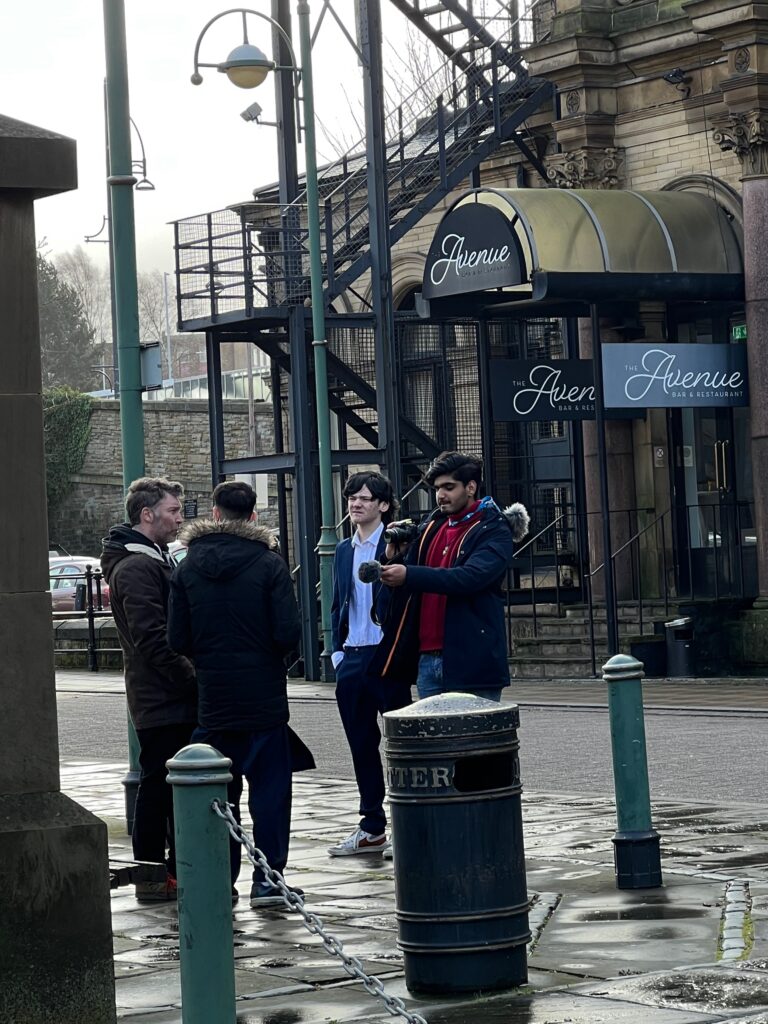
This is a little behind the scenes of what it looked like when we started filming. We found a neutral background, the people in front of the camera are facing towards it whilst the cameraman holds it steady. This particular photo was taken when we found a protester from the school strikes.
When we film our final show in the TV studio we will be prepared but this week we need to make the final changes to the intro, the music and have the script ready for the auto-cue in the studio.
This is our street interview that was filmed on the first of February. This as edited by Henry and we all agreed to make the street interview as comedy style to make our viewers laugh and enjoy the show whilst also answering questions we’d like to hear from the people of Bradford.
A producer hires writers for shows and films, and they oversee all parts off pre-production, production and post production. It is common for a film in pre-production to have several producers. Most producers are physically on set and are always in collaboration with the director.
The producers are one of the first people to start working on production. In the pre-production, they work to get investment and get financing for the film/show. They also work with a team of writers, to make sure production is on schedule and in their budget.
The producers work together to find a director unless a director hasn’t already been assigned to the project already. They also reach out to some big name actors and actresses for the main character roles in the film/show.
A producer works with a director to bring on creative people like a cinematographer, a production designer and casting agents. It is an important role for producers to fill and it is key to hire creative and team working producers so they can hire the best of people to work on a film or show.
Producers don’t really need a lot of equipment since they are less physical and more about hiring and keeping everything on schedule. Producers have scripts for the film/show on them, they have communication technology, like walkie talkies or just a smartphone so they are able to call agencies and people.
Vocabulary a producer would need to know:
‘Call sheet’ – The assistant director will put together schedule thats given to the cast and crew. It contains things like where and when they are needed on set and when they are filming. It is often called a ‘daily call sheet’.
‘Below the line’ – It refers to the line that separates actors, directors, producers, and writers from the on-set crew.
‘First unit’ – It refers to the people who are involved in filming the parts of the film that are of most importance. These scenes usually include the lead actors of the film. In giant productions there is usually a first and second unit.
Having a producer is of most importance because they are in communication with all the department heads, and they make sure everyone is doing their job. A producer is essential so when they are being hired it is important for them to have strong management and organisational skills. They must be creative thinking and have film production experience.
Camera operator
A camera operator has skills like framing shots, being able to select the appropriate camera lenses and camera cranes so they can portray scenes in the correct way, or the way a director wants them too.
A camera operator will need a video camera. The type of camera depends on what kind of content someone wants to be filmed. Next someone would need a tripod or a camera holder. This is so still shots can be filmed and and the camera is steady when certain shots are recorded.
Next they would need a microphone. There is usually a microphone holder on set but it is needed to the camera can pick up audio clearly for the final take. They would also need audio cables and headphones. These are connected to the camera and it is important for them to check over the scenes that they have filmed so that the audio is good and they are happy with the scene.
Lenses and batteries fully charged are essential if there is a full day of filming ahead of them. Having different lenses ensures they can get the shot thy need and having multiple batteries charged can make sure the camera does not run out of charge and they don’t lose any footage that is being recorded.
Vision mixers
They work on multi-camera TV programmes. They select was the viewers see on their televisions at home. They sit next to the director in the production room, in front of monitors, and they cut between the different pictures available.
Our Director Kenzie will be in the production room with me to ensure we’re getting the correct shots and we like the layout of the camera and where the presenters will be shown.
The equipment i will be using is a program and preview bus, and i will have a wireless headset to make sure i can hear our floor manager (Leon) in the filming room.
As a vision mixer I will make sure the cameras are set in the correct place so when I cut between cameras they are in the right place and we see a clear picture of the presenters on screen.
Typically a vision mixer would be found in a video production environment such as a production control room of a television studio. They need to know how to use the buttons so they can switch cameras easily when the director would like them to.
They require high levels of concentration to ensure a smooth production. They are required to work to accommodate production requirements. They should be able to multi-task effectively. They need to have strong visual awareness, stay calm under pressure and make smart decisions.
For my podcast i recorded with a guest and i found some areas easy and some areas difficult. When i did my research, i already knew what i was looking for. Since i decided my podcast was going to be about Daredevil, i already had a lot of information in my mind about old projects and new projects. I also knew about the actors/characters and only needed a few references from articles to help me have conversation starters.
When i was writing the script it was fun but also difficult at the same time. I had so many ideas on what i wanted to talk about but it was hard to start a conversation without going straight into the details. However, once i had started to write an intro i managed to talk freely with my guest. So my script was only needed for an intro, and my ideas were written on my phone so we. could ease our conversation into new topics every couple of minutes.
When we were recording the podcast i had my phone out with my ideas, i didn’t need a timer since it already told me the time and the equipment was set up and ready to use. Because it was already set up it was easy to do, and we just needed to start talking. I used some conversation starters that i had written before. Some didn’t work out so we. cut them out and replaced it. With the intros. and starters we didn’t like we were able to replace it on the spot and this would make it easier for us during audio editing later on when we had finished.
When the podcast was done i listened to it again to make sure i liked how the conversation flowed. As i said i didn’t have to edit a lot afterwards on adobe after effects. But before i imported it to adobe after effects i put it into garage band to change thee quality and volume of the podcast. The compression and EQ was changed to make the audio higher quality and 4k.
I have added a description and included a spoiler warning and how to listen to my podcast. The intro is approximately 30 seconds long and the same was used for the outro.
I presented it on the big screen and the podcast was uploaded to you tube so it was easy to show. Good use of music on the intro section. My feedback also told me that i had used good music on the introduction. This music was pulled from you tube and it correlates with my podcast, because it comes from daredevil, the show my podcast is all about. ‘The voice is clear and recorded ok, there is a bit of reverb’. I had edited the podcast tot the best of my ability but what could’ve been improved was the quality of the sound. The reverb occurred because of the room I had recorded it in with a friend and that was something I could not edit out. ‘The branding supports the podcast.’ Because my podcast was marvel based I got inspiration from Marvels social media posts and how they communicate with fans. I looked at merchandise they sell, what pictures and videos they tend to post and incorporated that in my logo and branding. ‘It was easy to listen to and works well has an informal podcast.’ This is what i wanted my podcast to feel like. I wanted it to be a laid-back, funny and informal podcast marvel fans could listen to. It also gave them facts, a laugh and more marvel content to enjoy. ‘Well done for including the comment box on your digital space.’ This was done for more feedback to be heard so I can improve and hear what people have to say. ‘There is a bit of over talking that can be hard to hear the conversation.’ This was a small problem when I was editing my podcast. When recording the podcast with my guest we had too much to say and i heard that we chat quite quickly, so when people listen out words may be incoherent. in the future I would ask myself to slow down and speak clearly, or i would have a subtitle option for people who may find it difficult to understand what we’re saying.
I confirm that the attached assessment is all my own work and does not include any work completed by anyone other than myself and sources have been appropriately referenced.
My feedback shows me what i missed and i know that now i need to add more detail and analysis on my research. I also need to show sources and references if where i got my information from. I need to add more explanations of the formats of podcasts and why they are successful or not.
I have been told my branding is good, however i have used existing images without the authorisation to do this. This means in real life i could be sued so it was not a good option. My audio quality is okay, but it could be improved my asking my guest to move closer to the microphone. My podcast also could’ve had proper dialogue and had a script instead of going off from certain ideas i had written down.
I needed to add more strengths and weaknesses of my project, so i know what i can improve on. I need to explore more areas and elaborate on what i have done. What i have learnt from this feedback is that i need to spend more time working through each task that i have been given and make sure i add a lot more detail to each part of my posts on digital space. This will help in future projects and i can take this feedback and improve on research and detail.
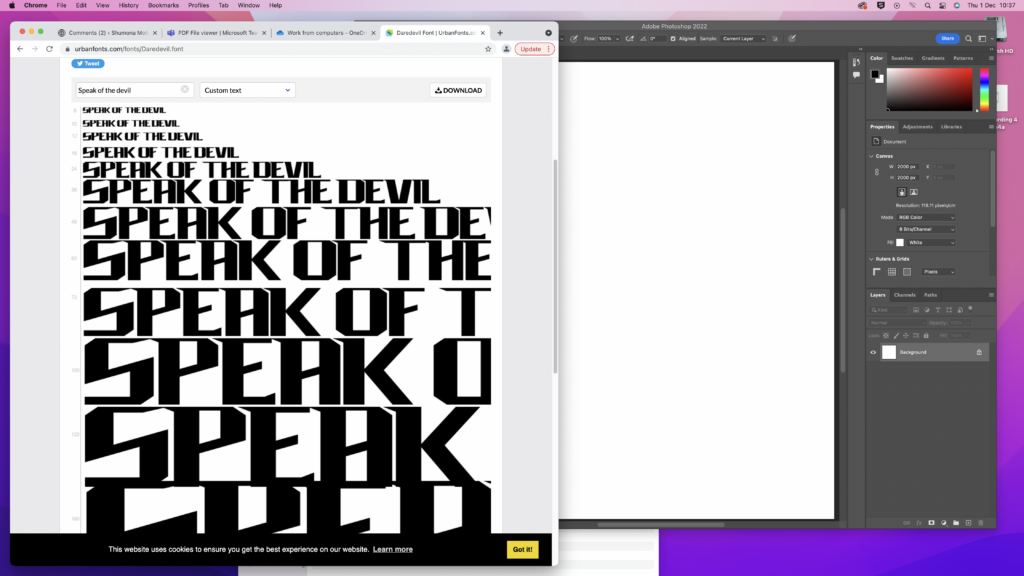
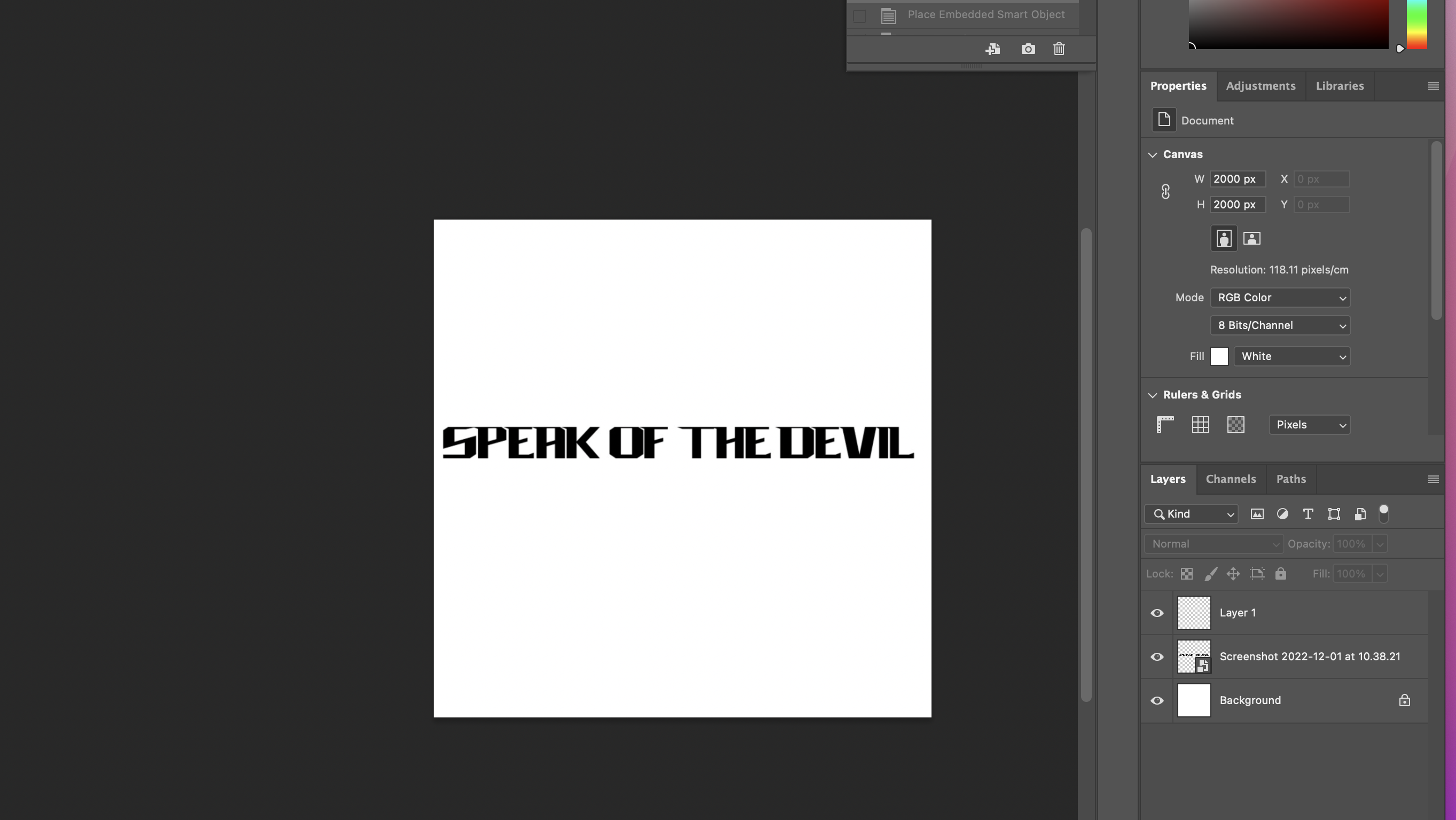
The first step of making my logo was making a title. I wanted it to be accurate to the show Daredevil so i used the same font and put it in my title ‘Speak of the Devil’. I used the website ‘Urban Fonts’, i then downloaded it and put it into Adobe Photoshop.
This was the finished product of my title
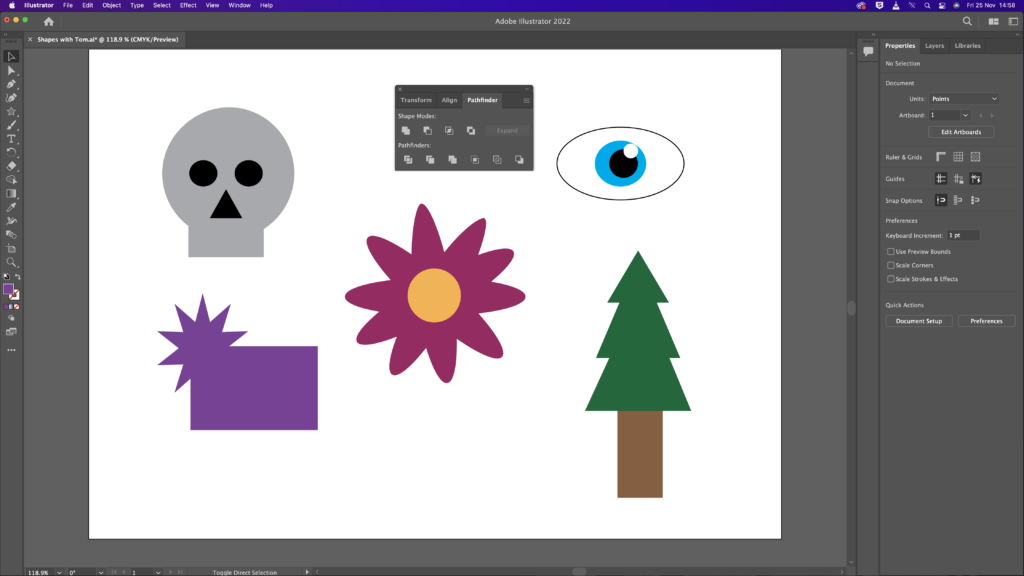
I practiced on adobe illustrator and made some shapes and changed colours. I wanted to be familiar with this because i had to make a logo and knowing how to edit on adobe illustrator would be quite important.
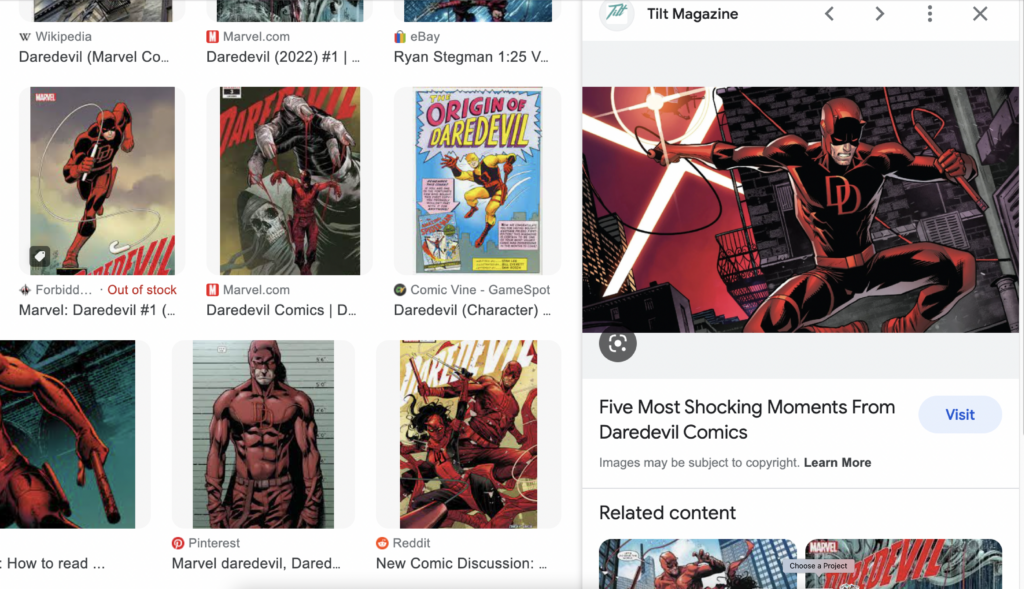
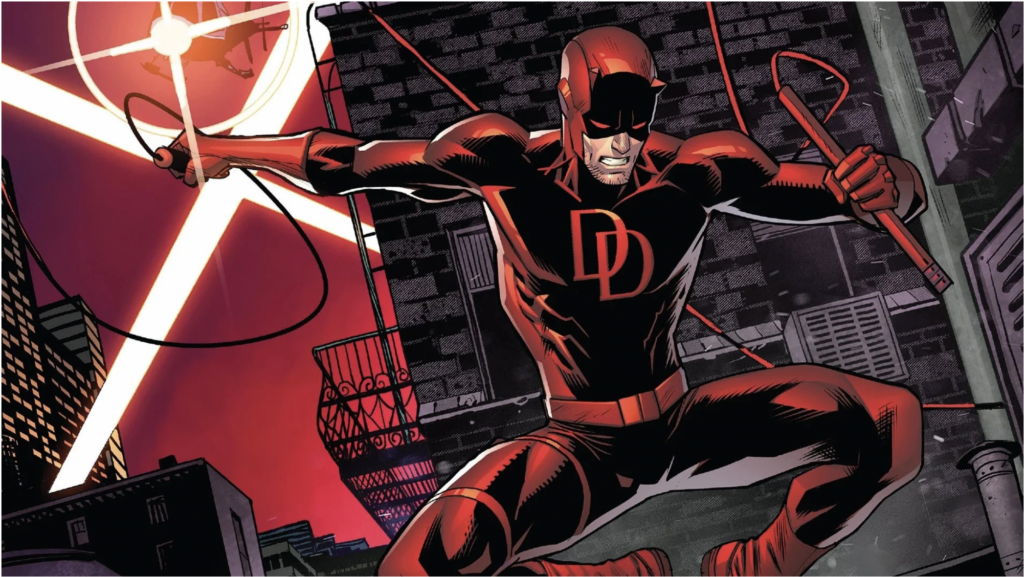
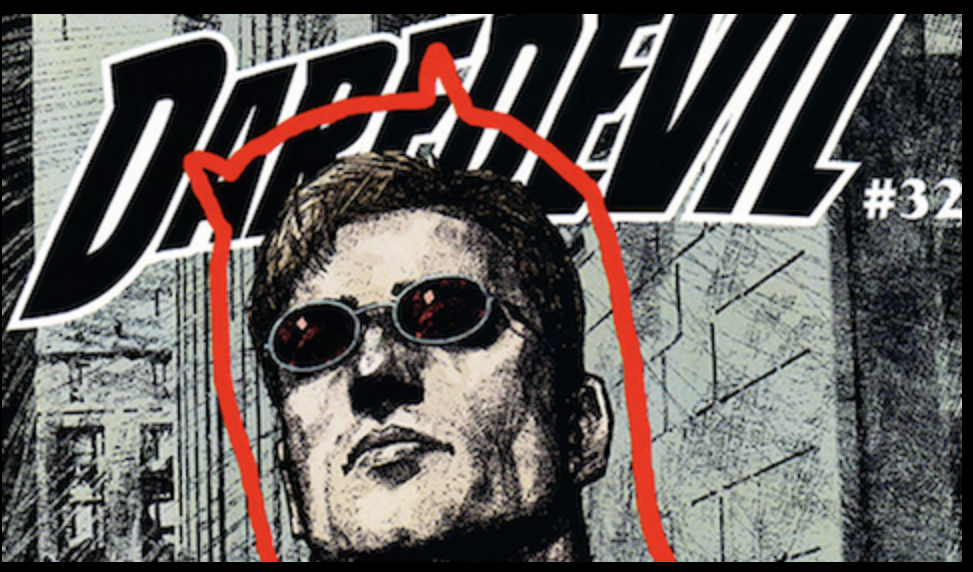
I searched online for a good quality picture of comic Daredevil. I wanted one that was bright but not too colourful because the show is dark. I found this one that i thought was perfect because it show him in his vigilante suit, his main weapon and him being in New York.
Next was adding a background. I went with the comic character instead of real life him to show that this is his origin and this was what inspired them to make the marvel show.
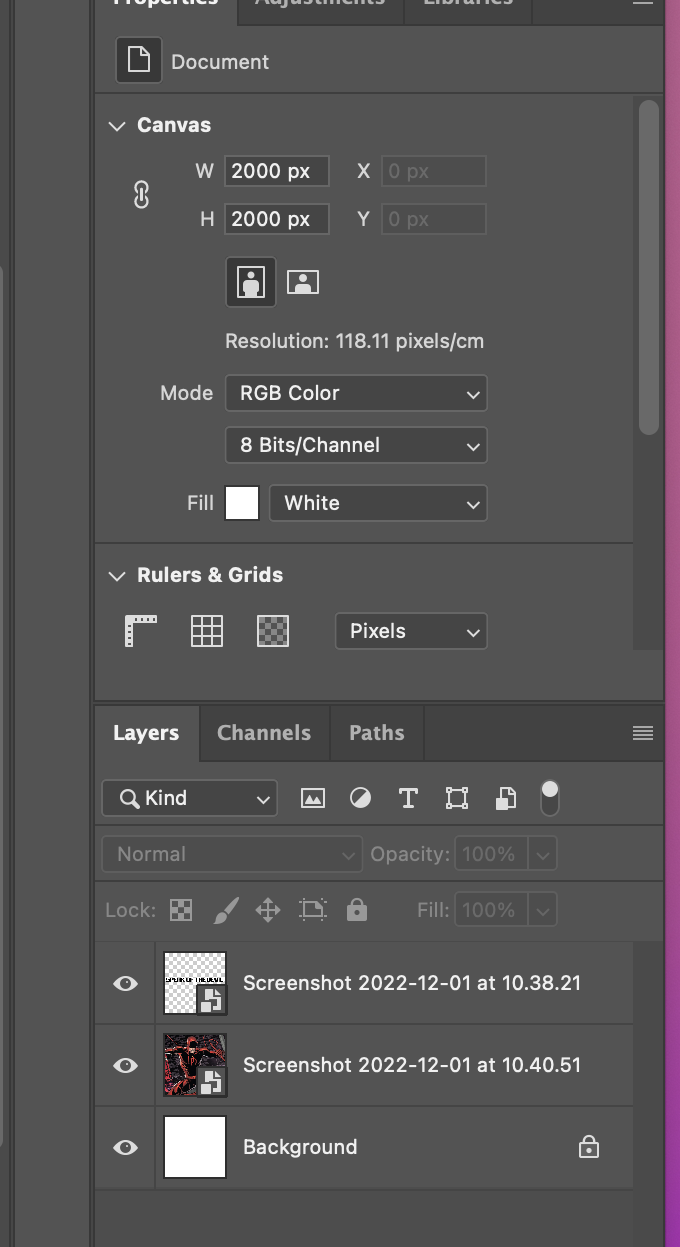
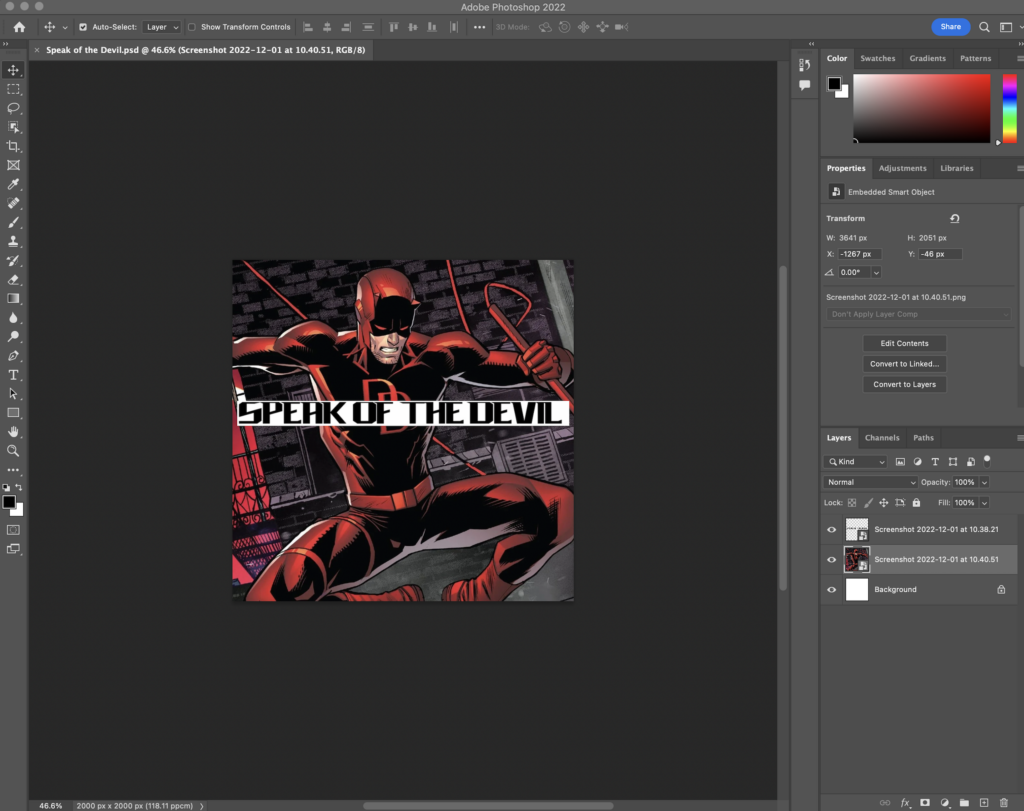
I first started with a white square, with the dimensions of 2000 by 2000. (width x height). I then added in the title of my podcast, transformed and scaled it so it would be in the middle of the square. I was happy with the title so i went and dragged the picture of daredevil and moved it to the back so the title was visible.
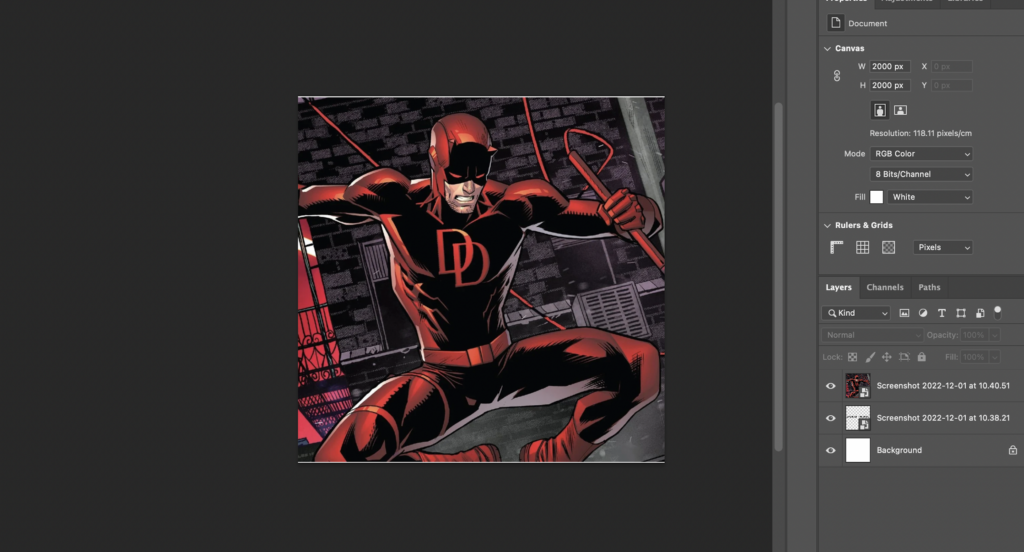
This was daredevil being put into the square. I went ahead and transformed and scaled it so it would be in the centre of the square, making sure the characters body was in the fame. There were still some white outline so i zoomed out and scaled it again.
This was after i scaled it and made sure there were no white outlines and that it properly it the frame.
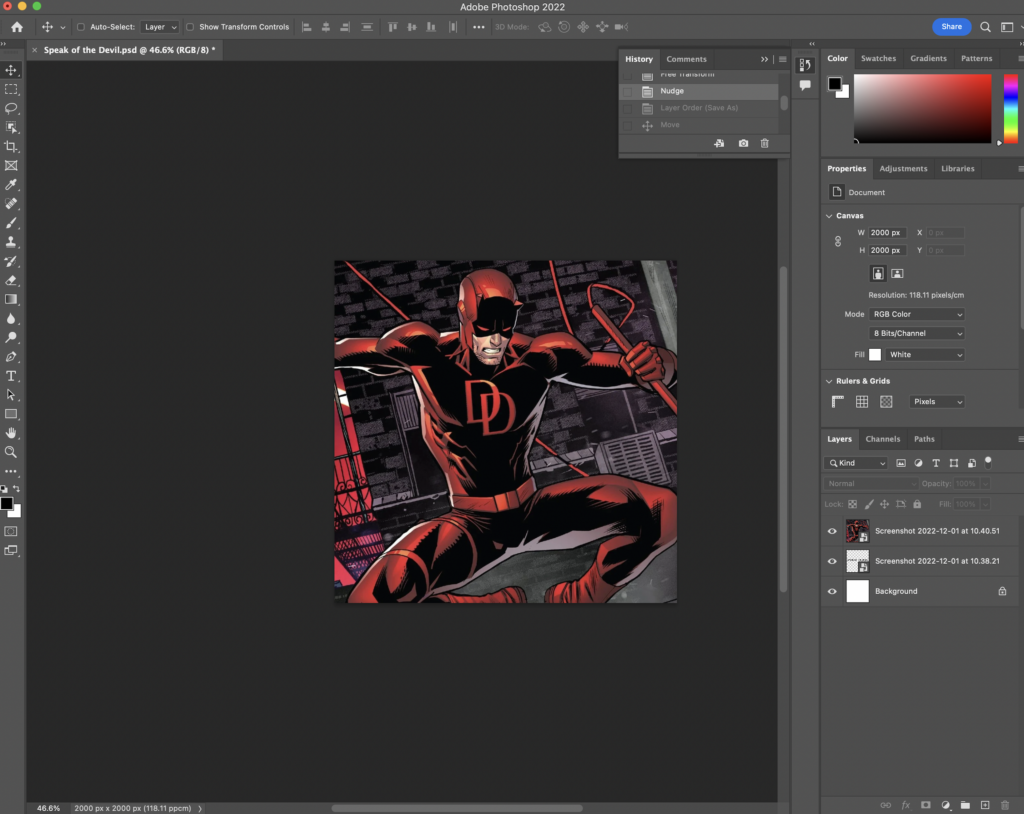
I made sure i could edit both the title and logo by making multiple layers.
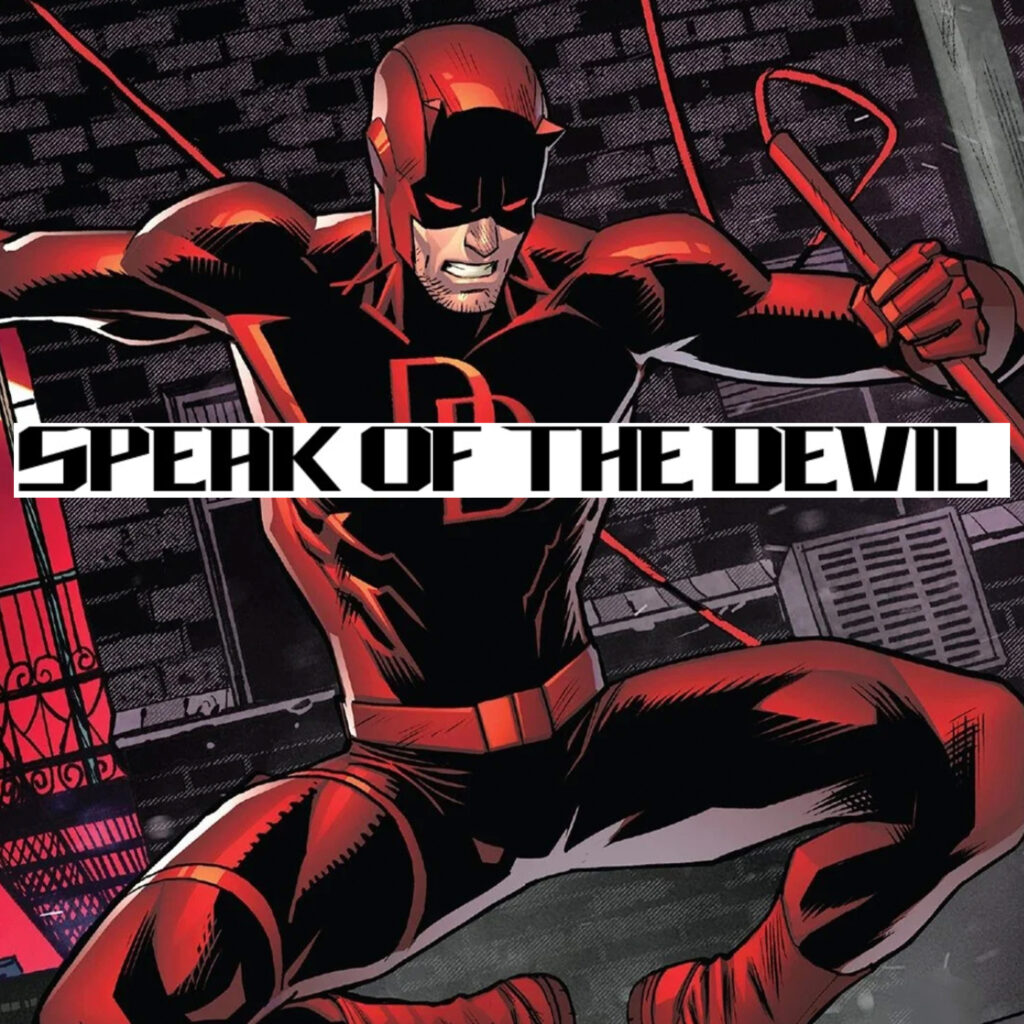
I then brought the title forward and my logo was complete!
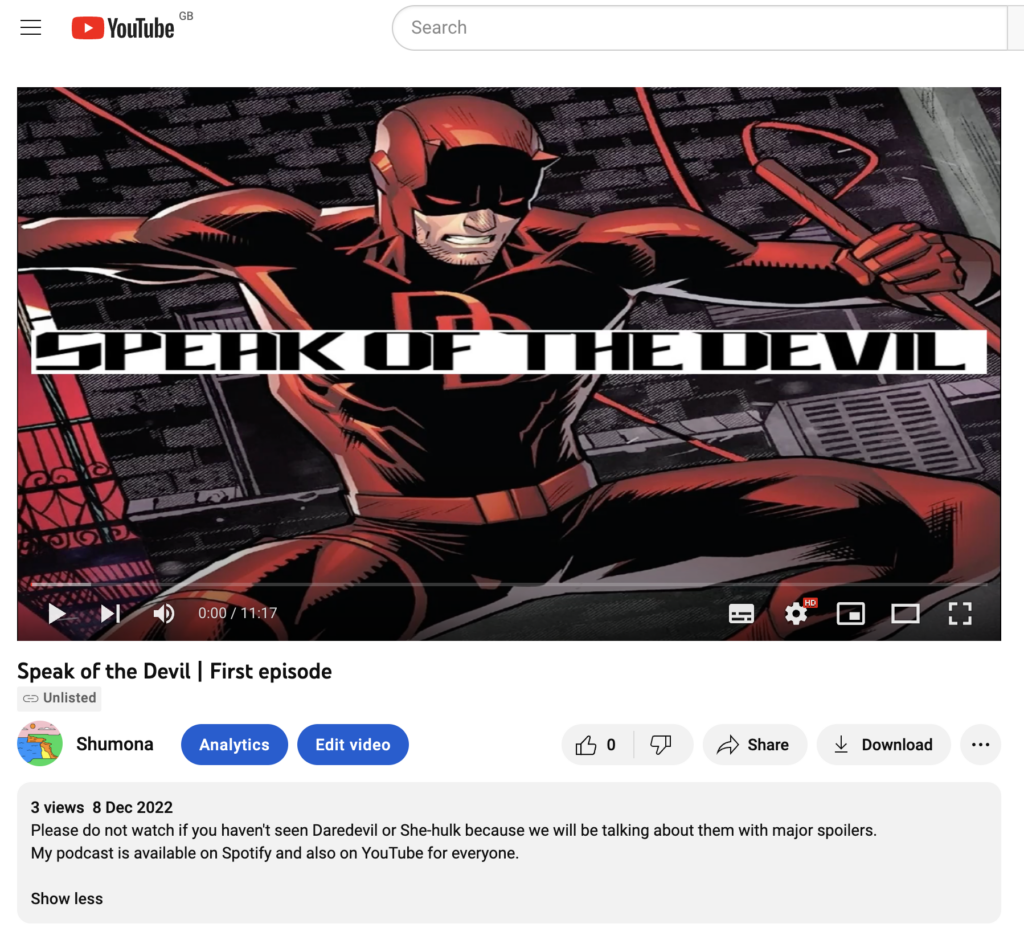
My official logo for my podcast, this logo will be shown on youtube and other platforms where the podcast will be shown.
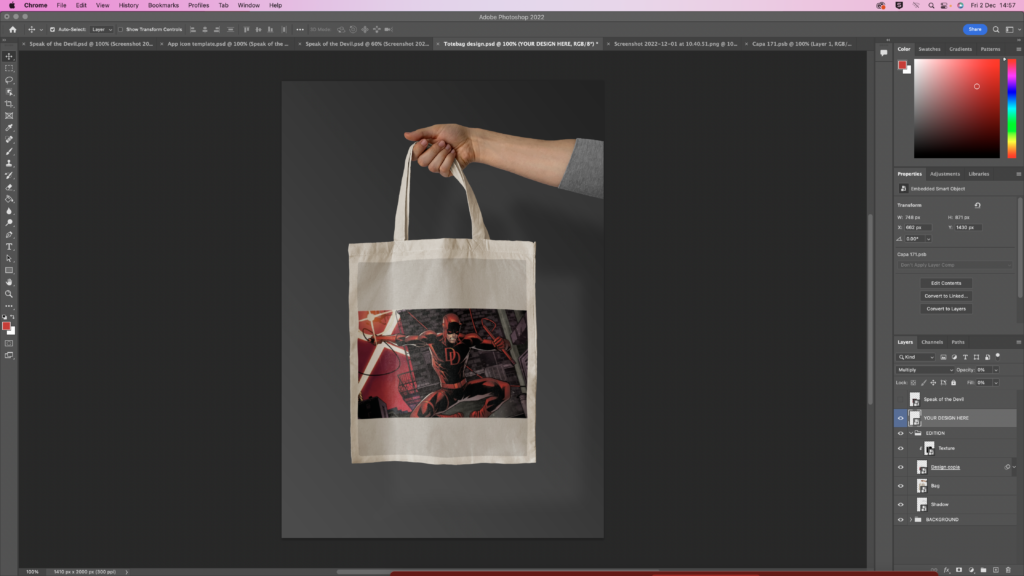
For my branding i chose to go with my original picture that is featured on my actual podcast. This picture will be the main one that will be on adverts, and merchandise such as this one. I added in different layers on photoshop so i was able to edit the colours, and move things around without ruining the layout.
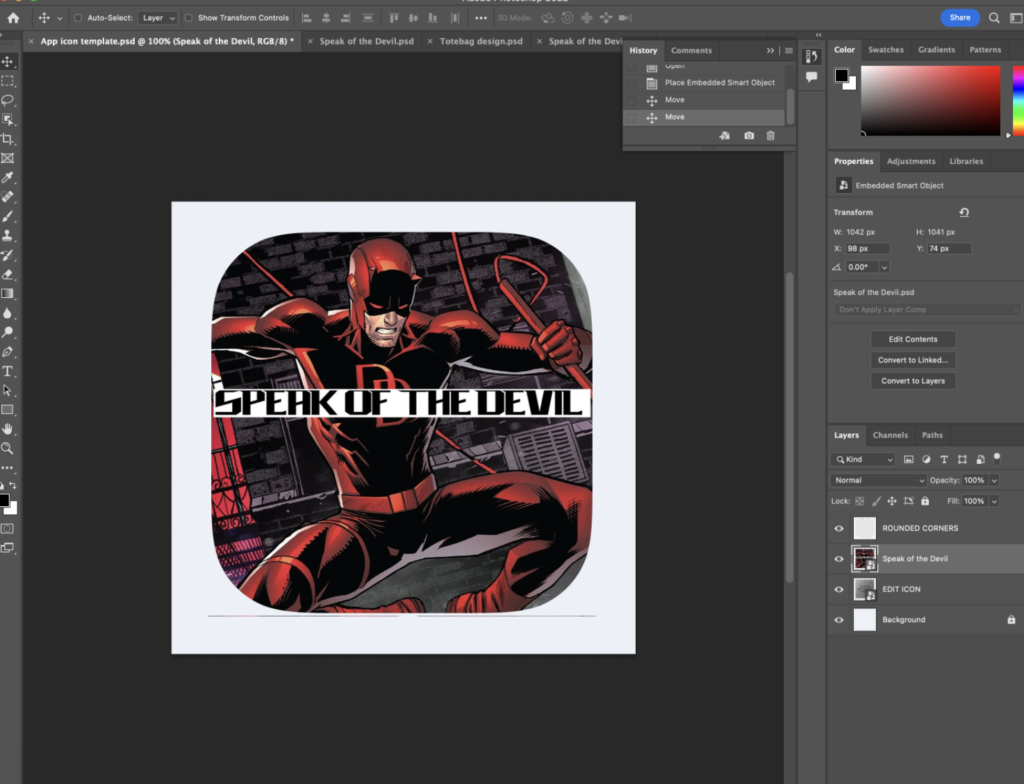
The logo is my app icon, and this would be used in the app store. This would be used as a digital platform. To make this i used a template and edited it on adobe photoshop. I imported my finished logo, and put it on top of the template. The template already adjusted the shape of my logo so i didn’t have to do any further editing.
Interactive functionality
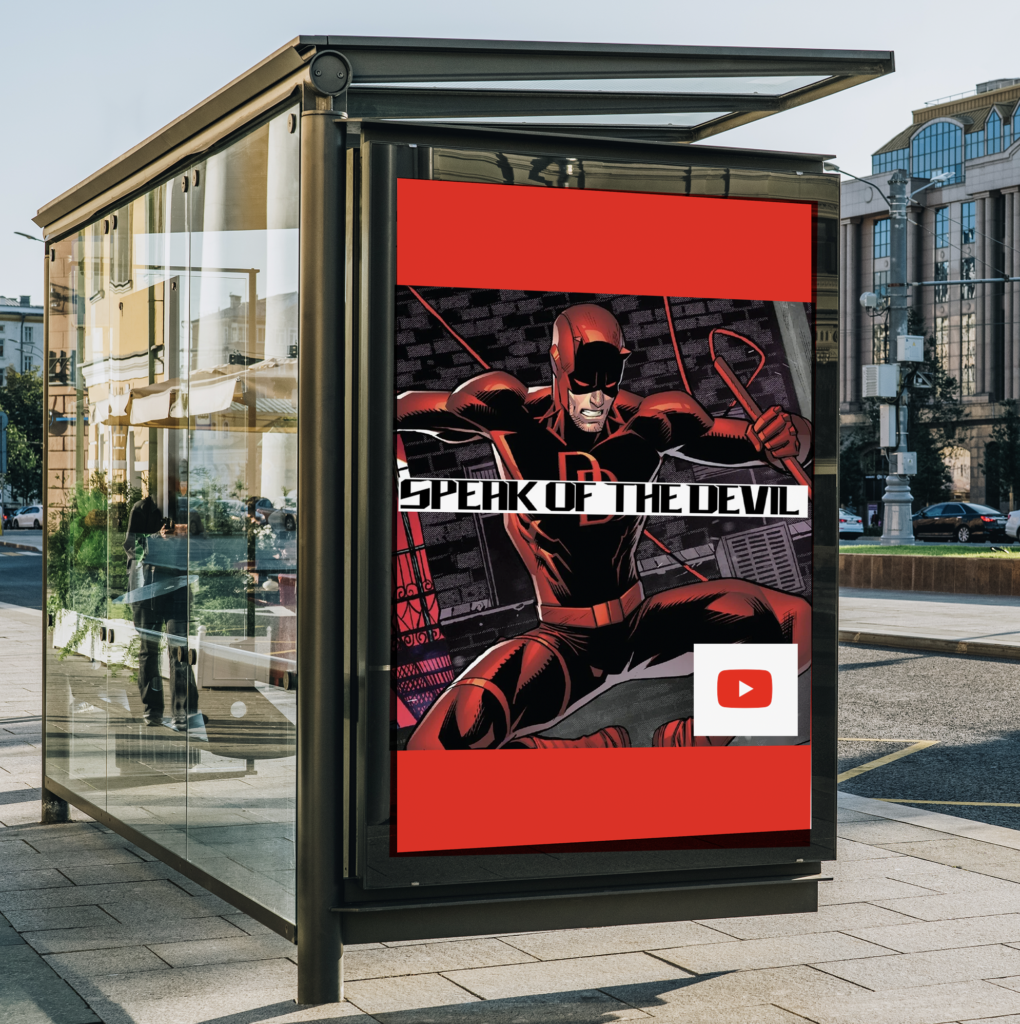
My podcast will be available to the public and it is for everyone to listen to. The adverts will be on bus stops, billboards and available on merchandise like tote bags.
I used more templates and this is my logo on a bus stop. I edited this on adobe photoshop, and i added a youtube logo so it is known that my podcast is available on there.
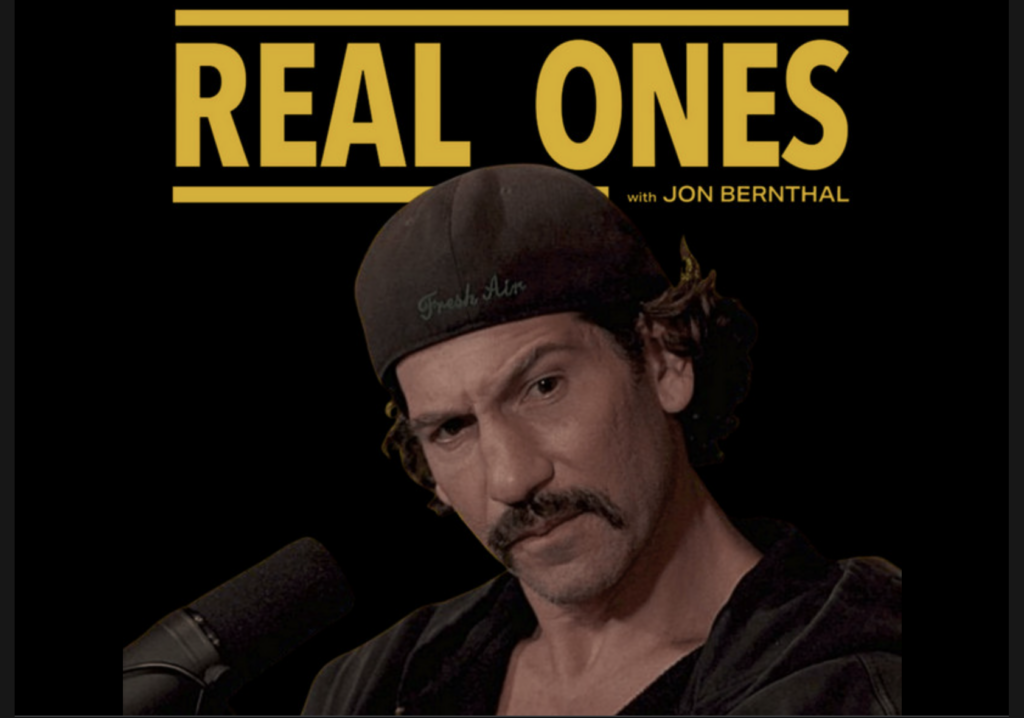
Real ones podcast with Jon Bernthal. His podcast all about talking with other celebrities. They talk about experiences in the film industry and how it had affected them positively and negatively. He is an American actor who is best known for his roles in ‘The walking dead’ (2010) and Marvel’s ‘The Punisher’ (2017). He interviews actors among other celebrities and sometimes, close family and friends.
His target audience (in my opinion) is mainly for over 18 people. He dives into important, sensitive topics with the guests eh invites to the show. He is a public figure, which helps his podcast reach out to a wide range of people across the globe. He puts all his podcasts on youtube and posts small clips on his instagram so it reaches even more people.
The format of this podcast is videos filmed to be put on youtube. He films in landscape so that the camera can capture both him and his co-star on the show. You can see the area around him, the background and his microphone.
The tone of this show is dark, and the things they talk about can be sensitive. But this podcast is important for people who want and insight on what it’s like to be an actor/actress.
His podcast has gotten a lot of reviews and opinions from people. All reviews i’ve seen have been positive and praise him for having a good, quality podcast. From chartable.com, a listener from apple podcasts says, ‘literally the only podcast i determine is worth a listen’. The podcast was released earlier this year and there are nothing but good comments under his videos.
Real ones – Jon Bernthal
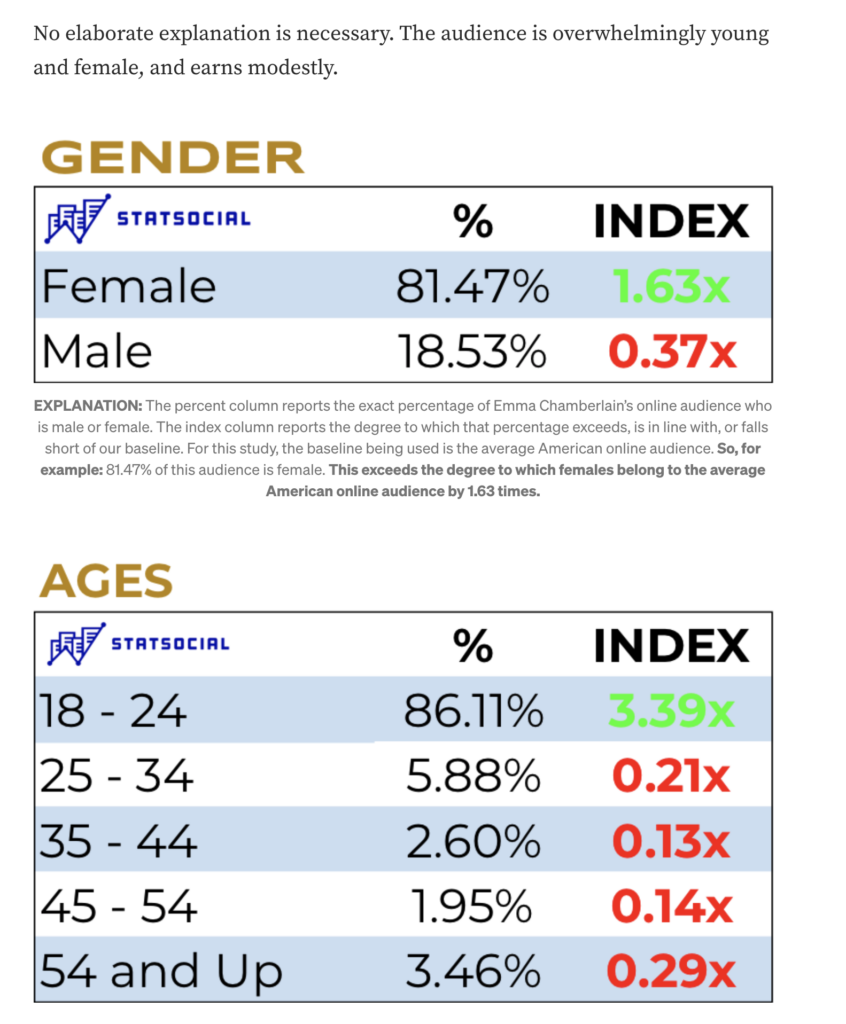
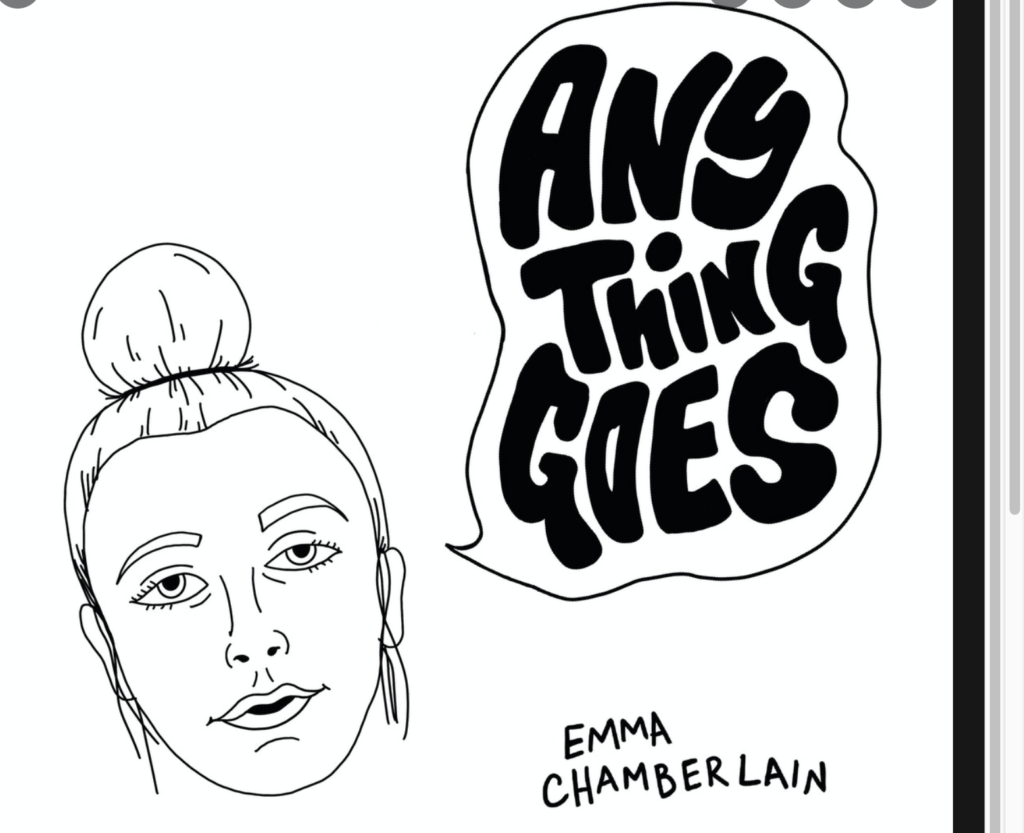
Anything goes by Emma Chamberlain. She is an online content creator who usually does vlogs about her daily life and travel. She talks about life, grief, boredom, anger and more. Her target audience is mainly 18 and upwards (image of these statistics below). Her talks are usually light and about her everyday life. She talks to us and she describes it as if she’s having a conversation with us. She occasionally has a guest on the podcast, but it’s mostly just her on her own.
Emma has a lot of media exposure and she has been doing this for years. Before she released a podcast she filmed herself living her life. She only records her voice, and doesn’t film herself. She posts her podcasts on the platform Spotify and the apple app, ‘podcasts’. She has a logo for her podcast so it is easily recognised by other people.
She started making youtube videos years ago where her target audience was mainly 15+ teenagers. Now that she’s grown up her content has matured and the podcast is good for people who are growing up. It’s good for people who need help getting older, as she gives life advice, how to deal with certain situations and daily life hacks. As a fan, i have been watching for years and her podcast is perfect for people who have been watching since they were younger and are growing up.
Her content has changed over the years going from daily videos uploaded to podcasts being released every week. Her audience is mainly female, and between the ages of 18-24, according to the stat-social insights website.
I asked classmates if they would listen to a podcast like this. Many people in class are marvel fans and this would be a podcast they would be interested in. I had a conversation to my guest talker and since she’s a marvel fan she liked all aspects of my podcasts. She says she likes the conversations about the future projects and when we talked about main features of the storyline.
With secondary research, there are many articles for example from the Washington post. I have quoted them on my podcast and they are in my script. Because marvel is so global and for all ages, that also applies for Daredevil.
Podcast Production Proposal
A proposal is a document that presents the idea of your podcast before writing the script. Proposals are often written in present tense, in a narrative-like prose, and highlight the most important information about your podcast, including name, theme, content and potential guests. Proposals are often used in the initial stages of idea generation and will be used to support a pitch and sell your podcast idea to producers or production members.
This document should aim to be between 500-800 words in length. Add in links, found imagery, and other media to support your ideas.
Title (can be a working title)
JSS (Just survive somehow, an important part of the show)
Summary (What is your podcast about? How long will it be? Where will it be listened to?)
The podcast will be about the walking deadIt will be approximately 10 minutes longIt will be on You tube so everyone can listen to it easilyThe target audience will be people aged 15 and upwards since the age rating is also that age
Subject Specifics (Research and idea development: what topic is explored through your podcast? Does this sit within a wider genre?)
The finale and the very start of the showHow the show came to be (comics by Robert Kirkman)TV Movie and Tv Award for best villain – Jeffery Dean Morgan (2017) Talk about Negan and how he changed the characters’ lives and a new perspective for the audience.
Audience (Who would listen to your podcast, when would they listen, and what characteristics do you know about your audience through research? Age? Gender? Nationality? Are there any special considerations you need to make for your audience?)
People aged 15 and upwards. They would listen to this when they have finished the show or certain episodes Through my research I have found out that people enjoy films and Tv shows the most, this makes my podcast more likely to be listened to by the people who enjoy these genres. This podcast is also for all genders and for special considerations we would make disclaimers at the start of our podcast saying that we will be talking about certain episodes and that there will be spoilers (or certain seasons).
Podcast format (one-to-one, solo-commentary, panel, fiction, non-fiction etc).
One-to-one Fiction
Influences (Which podcasts have you looked at? Find podcasts that cover similar topics and discuss how they are presented. If possible, provide links to content.)
The talking dead (they talk about actors, props, behind the scenes, makeup artists, producers and directors and certain characters)
Real ones (all talk about how filming is done on film sets, what happens behind the scenes and features actors from the walking dead)