Some techniques used in the composition of film and theater music are:
A leitmotif: A musical representation of a character, place or thing. The composer will play this everytime that specific thing shows up in the film or play. This is useful as you can repeat the same part and it will sound good as the listener has created an emotional connection with the leitmotif and whatever it represents. There are also musical motifs, which are shorter phrases that are usually used to represent emotions or plot points, they are similar ideas. A sting is another name for a musical motif in a different setting.
Tempo and rhythm: Using different tempos and rhythms can create different moods for different scenes. A slower tempo and rhythm are usually more tranquil and work for slower scenes, but a faster tempo and more going on in the rhythm create more tension and excitement.
Orchestration/instrumentation: The choice of instruments and the way they are arranged. For example a full orchestra creates a sweeping, epic sound whereas a solo stringed instrument will create a tranquil and calming sound. An orchestral score will envoke completely different feelings than an electronic score. Orchestral scores became the standard for film music since 1933 when Max Steiner composed the score for King Kong, and had a revival in 1977 due to John Williams iconic Star Wars’ score. In the 70s and 80s, composers and musicians were experimenting with synthesizers and a different kind of film score. Scores such as Blade Runner, Apocalypse Now and Knight Rider were some of the first to use synthesizers and started a new way of composing film music. As you don’t have to be a classically trained musician to use a synthesizer, it opened up film composition to a wider audience. It also creates a completely different feeling to an orchestral sound, it also creates a much more varied sound and the music isn’t stuck in a couple different genres.
Simplicity and re-using melodies: Simplicity is the key to film and play music. As the music is not the main focus and is something in the background to enhance the film or play. It is good to be repetitive as that can be a musical or leitmotif, and it allows you to develop an already existing melody which makes the film or play more cohesive, instead of having a completely different song.
How does music enhance a film or play:
Music is the key to setting the mood and atmosphere. Even if the audience doesn’t realise it, the music is what makes the scene feel either tense, calm, romantic or whatever feeling the scene is envoking.
Music is great for scene transitions in plays. Inbetween scenes when the actors are changing about the props for the next scene music is often used to mask the sounds of props being moved and to keep the audience engaged up until the next scene starts. It can also help with the pacing in a film, for example montage scenes or scenes where things happen but there is no dialogue, music can be played which helps keep the audience engaged and keeps the film feeling like its moving at a brisk pace.
Music is good at emphasising key moments in the film or play. Climatic scenes, or character moments can be enhanced by adding music, especially if it is a leitmotif that has been expanded upon as it is the climax of the film so it is the biggest, loudest and most epic sounding music in the score. (Rotondo, 2023)
Musical ideas/techniques:
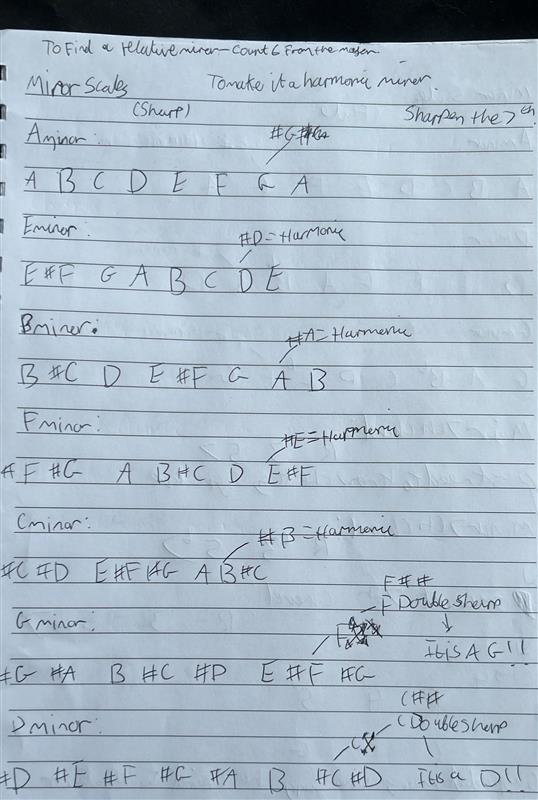
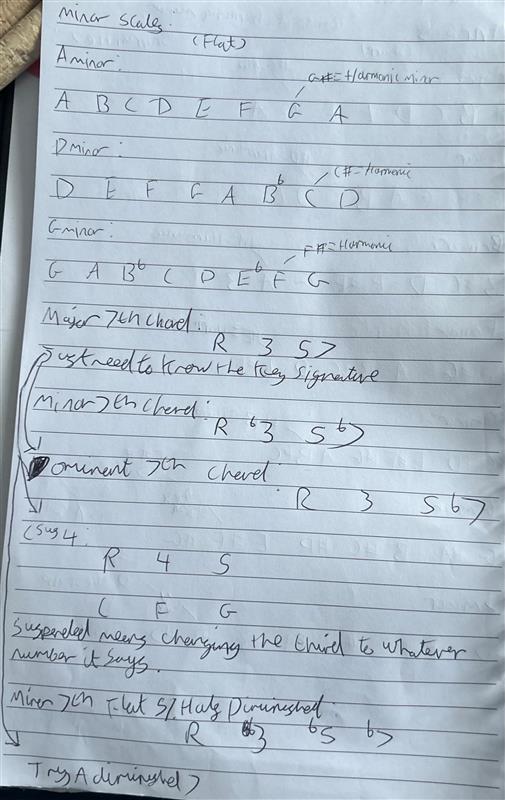

Some research I did for this project was improving upon my music theory knowledge. I researched about minor scales, relative minors, and the whole tone scale. I also learnt about different chords apart from the basic ones, such as a dominant 7th chord, diminished 7th, minor major 7th and more. I hope to apply this theory research into my compositions to make them more interesting and better pieces of music.(lovemusicshop, 2016)
Rotondo, Giovanni. “Decoding Why You Love That Film’s Score.” Film Scoring Tips, 9 Oct. 2023, filmscoringtips.com/decoding-why-you-love-that-films-score/. Accessed 5 Jan. 2025.
lovemusicshop. “List of All Natural Minor Scales.” Piano Music Theory, 1 June 2016, piano-music-theory.com/2016/06/01/minor-scales-natural-minor-scales/. Accessed 6 Jan. 2025.