Introduction
For my work experience I considered three options, The Underground, Jam on Top and Bradford Music Education Hub. The Underground was never my first option, as it would only include shadowing or bar work/helping out at gigs, I can do this at Jam on Top as it has a venue, so The Underground was a backup plan. Bradford Music Education Hub involved teaching children the basics of music, this was always my second option as teaching is not my main career goal. I chose Jam on Top. This placement involves shadowing the owners and learning how the place runs, sorting out the rehearsal rooms and eventually being able to do it myself. There are a variety of tasks including helping with gigs, shadowing the sound engineer, potentially bar work and handling lighting, cleaning and general maintenance. The variety is why I chose this as my placement as it will keep the experience engaging and enjoyable. I would also like to learn about running a business, what it entails and how to do it. As I have a good relationship with the two owners, I will be able to get valuable information from them. Helping at gigs appealed to me, as I already have some experience from playing small shows and would like to increase my knowledge even more. It was also the easiest place for me to get to, as it is only a 10 minute bus journey from my house, the closest out of all these options. And as I knew the owners and know the place really well, it was my preferred choice.
Pre-Placement
It was quite easy to get my placement here as I already knew the owners. All I had to do was contact them via a text message. I already have their number as I use Jam on Top as a rehearsal place. That was then followed up with a in person chat which confirmed that I would be working there, and my shifts would be 5-10 on a Tuesday evening.
Jam on Top
The main task I carried out during my placement was preparing the rehearsal rooms for when the first band would arrive. This involved making sure the mixing desk was turned down before powering anything on, switching on the amps to give power to the speakers, adjusting volume levels so it is at a good volume yet doesn’t create feedback, then turning the desk on, I would then plug the mics in and set the levels, EQ and effects. I’d also check the schedule with the owners to confirm how many microphones each band needed.
When the band arrived, I would direct them to their room, provide them with a cymbal box, this was box that had essential drumming parts like a hi hat clutch and the felts and rubbers, these are kept separate to prevent loss or theft, I made sure they had the right amount of microphones and asked if they would like any drinks. I used the till at the end of sessions, which was a simple tablet system. I just needed to ask how many people were in the band and how long they rehearsed for so I could charge them the correct amount.
Between sessions, I helped out with various tasks. This included cleaning the bar, washing glasses using a tabletop dishwasher, and putting them away; I did this a few times. I also coiled and organised spare cables, and helped clear the entrance for fire safety compliance – removing any flammable items from near the fire exit.
During my first two visits, I shadowed while helping out, after that I took on more responsibility. There are 5 rehearsal studios, we would split the work, taking two rooms each and we did the last one together, if it was fully booked. The first 4 studios were similar to each other, except studio 3, which had active speakers with built in amplifiers, so there isn’t an amp to in this room. This meant instead of turning the amp on like in the other rooms, you turn the speakers on first instead. Studio 5 was unique, as it is the venue space which is called Studio 5 Live; they use it for an extra rehearsal space.
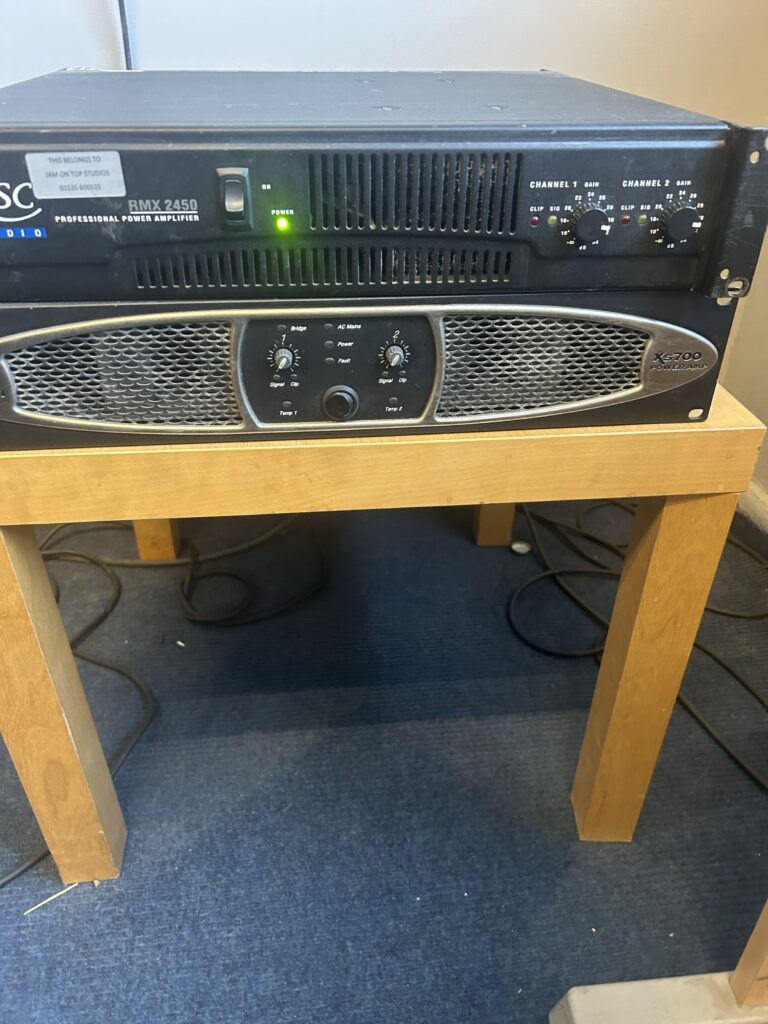
This is one of the amps in a rehearsal room.

All the rehearsal studios, except studio 5, use the same mixing desk. These desks offer a range of built in effects. For enhancing vocals in a rehearsal space, plate reverb is generally the most effective option, as it adds warmth and depth to the sound.
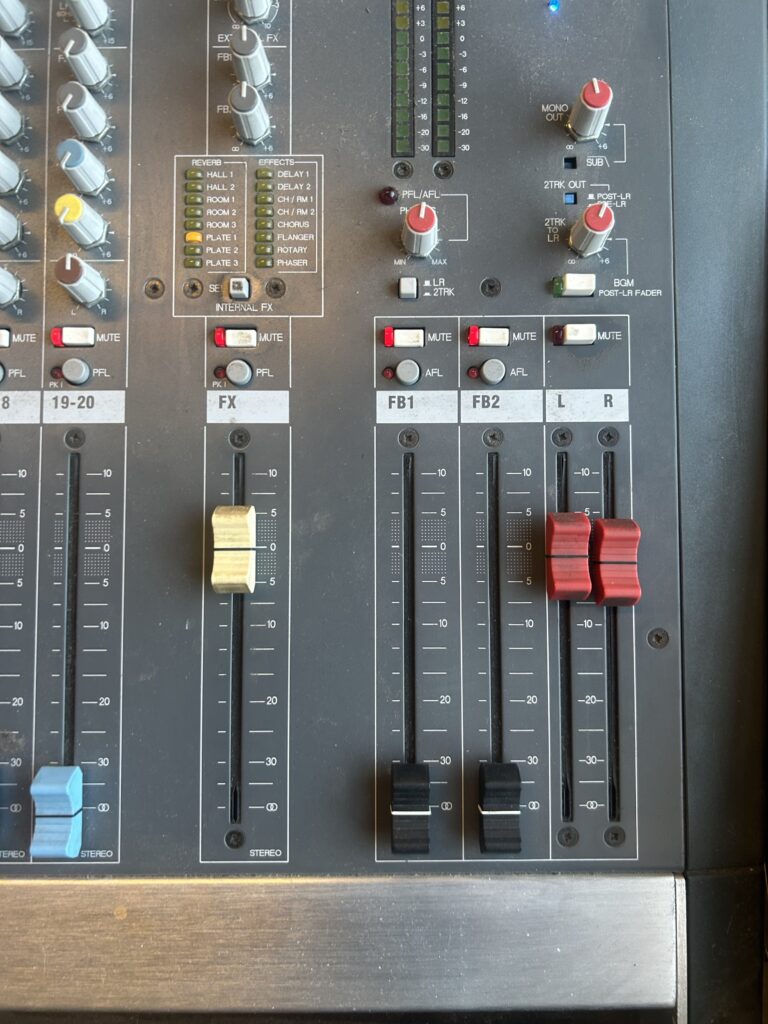
In this setup, the FX(effects) slider, is a set too high and can make the effect sound overpowering. The master volume(the red one) should be set up to the highest possible level without causing feedback.
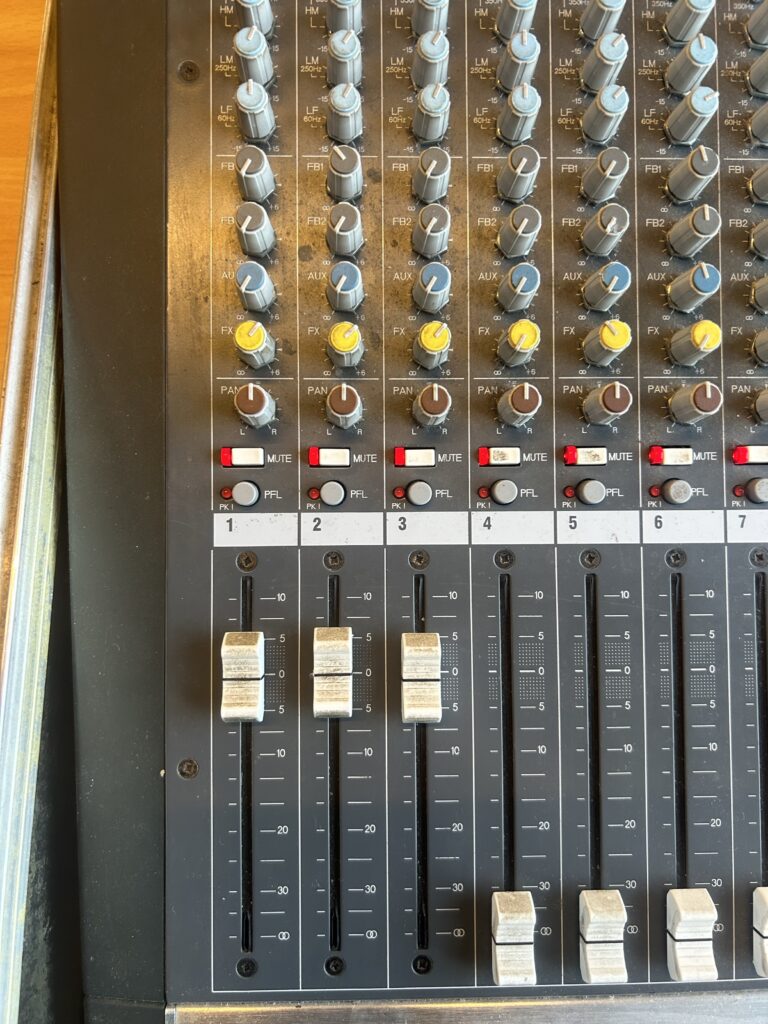
In this setup, three vocal mics are connected. The level should be set around 0 db, or as high as possible without causing feedback,especially if the vocalist is quiet.
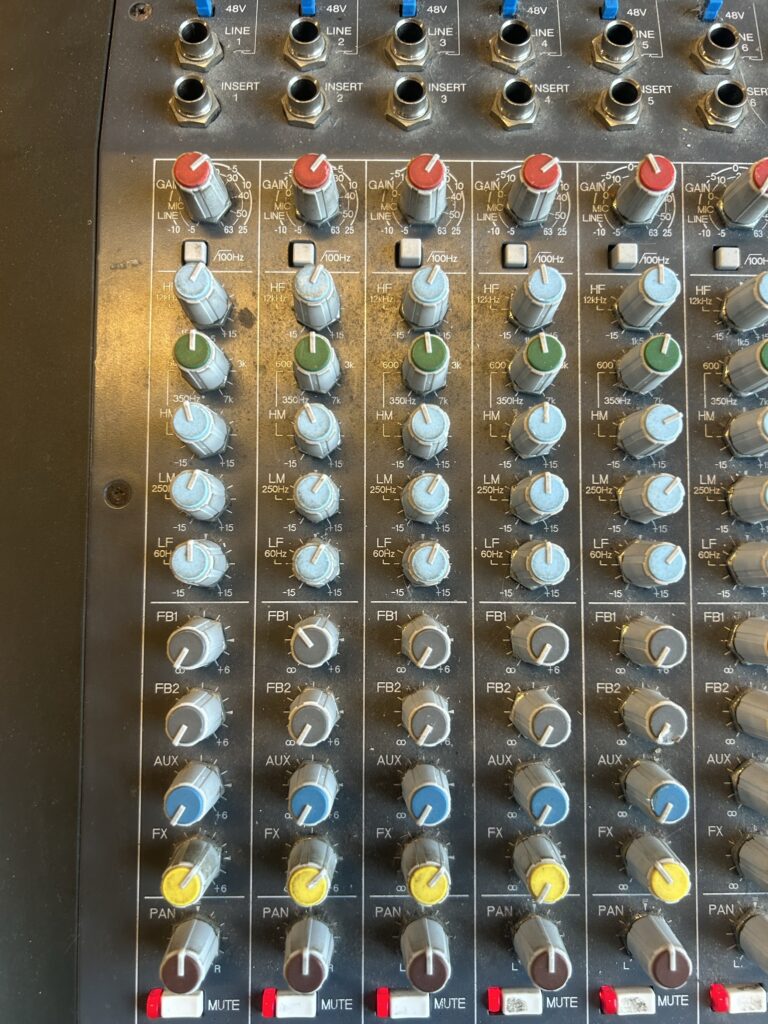
This image show the EQ settings. Based on what I learnt here and from past experience and from what I’ve heard in sessions, this is a good EQ for live vocals:
- High frequencies slightly boosted, especially for male or low-pitched voices, but sometimes left flat depending on the singer.
- High mids: Typically cut out as they can sound sharp and nasal. Reducing them can smooth out the vocal tone.
- Low mids and low frequencies: Often boosted to add warmth, presence and clarity, but this depends on the singer; some voices sound better with these left flat or even slightly cut to avoid a boxy and thin tone.
The EQ should always suit the individual vocalist. If it sounds good naturally, minimal tweaking is best. The FX knob on the channel strip must also be turned up to send signal to the effects unit. The gain is usually set around +30 db, just above center, as it provides the vocal with more volume and presence, but any higher will distort it.
Studio 5 Live:
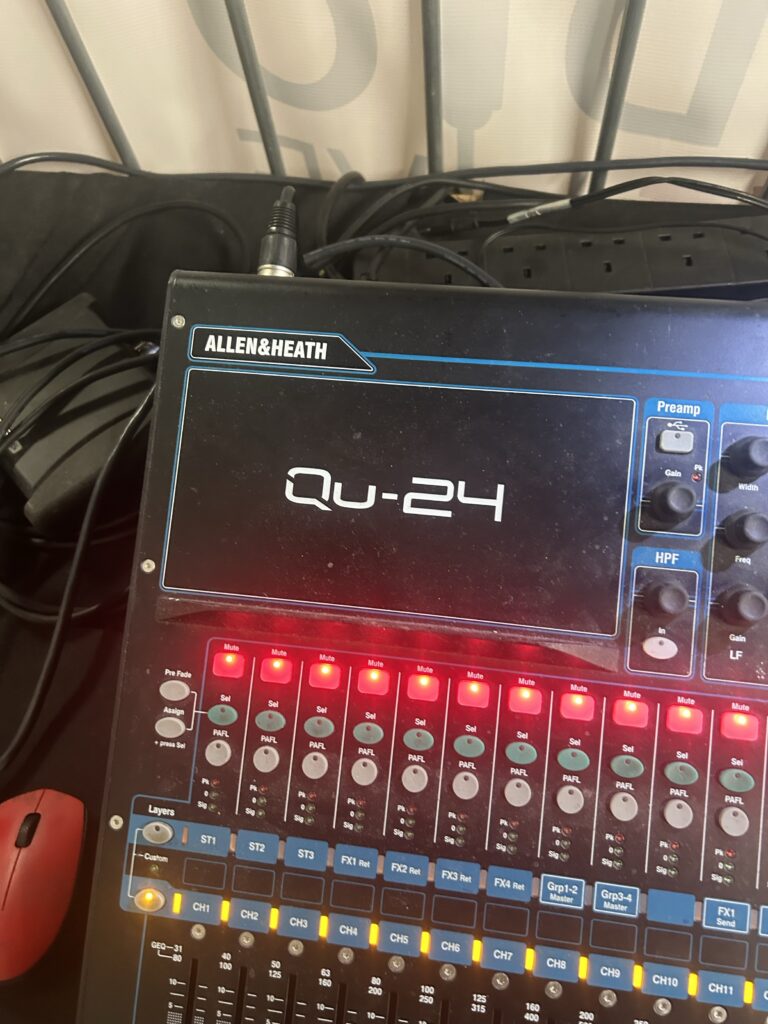


Studio 5 had more of a complicated desk and set up, due to it being a venue. The speakers were much larger, and powering the system involved switching on multiple components including three amplifiers. The desk is an Allen & Heath QU-24. It is the same principle as the other desks, however, it offered mire advanced features. One key difference was the presence of multiple monitor mixes, as seen in the video. These mixes are used to send audio to the on stage monitors, allowing the performers to hear themselves clearly. There were 4 monitors, one for the drummer and three at the front of the stage. Therefore, four mixes had to be done. Due to this, a brief soundcheck had to be done at the start of each rehearsal. It was already set up in a basic manner but each performer and band is different so they will want different instruments at different volumes in their monitor mix. The drums had microphones on, the bass drum had a mic on it and one overhead mic in channel 1 and 2. The drums to be mixed on the desk as well as microphones, and put in the monitor mixes. The effects section was more advanced, offering reverb, chorus and compression. The reverb on the QU-24 sounded much cleaner and to a professional standard compared to the desks in the other rooms.
Evaluation
Using Jasper’s ERA model(2013), I shall evaluate my work.
My experience at Jam on Top was positive, I learnt some valuable information about live sound mixing: how to use mixing desks and the correct kind of EQ and effects for rehearsal rooms; what an amplifier does and how to use them; and the difference between active and passive speakers. It was enjoyable to work here as it is a nice and comfortable environment. Although I already work at Asda and regularly interact with customers, this placement helped me build confidence in a different way; greeting clients, taking the lead in preparing rooms, and managing small responsibilities independently. These were new challenges I handled well. One of my goals was to gain insight into the business side of running a rehearsal studio. While I had the opportunity to observe the owners at work, I didn’t receive much detailed information or guidance in that area. The owners have a very relaxed approach, yet the business has remained successful for many years. It was interesting to see how they manage things calmly without stress, though I would have liked to learn more about their day-to-day operations and decision making. Unfortunately, I didn’t get involved with Studio 5 Live. There was an opportunity for one gig, however due to scheduling conflicts I couldn’t make it and they don’t put on as many gigs as they used to. This gig would’ve involved: shadowing a sound engineer, helping out with setting up and packing down, and assisting with lighting. This is disappointing as working on live events is an area I’m interesting in pursuing further.
Overall, I could’ve gained more from my placement. Although I enjoyed my time at Jam on Top and did learn valuable skills, there wasn’t always a lot of work to do, and opportunities were sometimes limited. In hindsight, I could’ve combined Jam on Top with working at Bradford Music Education Hub for a different experience and develop a broader skill set. Once I knew I wasn’t getting involved with Studio 5 Live, I should’ve got in contact with The Underground to help out at gigs. This would’ve given me the experience of working at live events that I wanted. Whilst I still learnt on my placement, I should’ve taken a more proactive approach to this, and once I knew I wasn’t getting everything I wanted from Jam on Top, I should’ve reached out to the other places I considered.
Reference list
KEF (2024). Active vs Passive HiFi Speakers: What’s the Difference? [online] KEF UK. Available at: https://uk.kef.com/blogs/news/active-vs-passive-hifi-speakers?srsltid=AfmBOooveJQ_JJ3zu8fhhz-OjUar_vFcVxdUg-1AxOsrcQy9hqKcjsJj [Accessed 29 Apr. 2025].
Creative, V. (2014). Qu-24. [online] Allen & Heath. Available at: https://www.allen-heath.com/hardware/qu/qu-24/ [Accessed 29 Apr. 2025].
The Underground (2023b). The Underground Homepage . [online] The Underground. Available at: https://www.undergroundbradford.co.uk/ [Accessed 29 Apr. 2025].
Bradford Music & Arts Service (2025). Home – Bradford Music & Arts Service. [online] Bradford Music & Arts Service. Available at: https://www.bradfordmusiconline.co.uk/site/ [Accessed 29 Apr. 2025].
Virtuoso Central (2020). How to EQ Live Vocals – Mixer Settings for Vocals. [online] Virtuoso Central. Available at: https://virtuosocentral.com/how-to-eq-live-vocals/ [Accessed 29 Apr. 2025].
I used ChatGPT to make my work more concise and polished.