I am going to be looking at three different performances and how they were received. I will be looking into a performance of the UK National anthem in 1977, a Sex Pistols performance in 1977 and a performance of God Save the Queen by the Sex Pistols in 2007.
God Save the King (or Queen, depending on who is the monarch) is the English National Anthem. This song is intended to provoke nationalism/patriotism and is a way of showing your pride and love for the country.
God Save the Queen is a song written by The Sex Pistols and was released in 1977. The song was very controversial at the time due to its lyrical content, which criticised the Queen and the Royal Family and compared them to a “fascist regime.”
Reception theory is the theory that a text can have different meanings to different people. The author will usually put a message or put their values in their piece of work, and depending on who the audience is, it will have a different meaning. There are different kinds of positions an audience can take when decoding a text, these are preferred reading, oppositional reading and negotiated reading. Preferred reading is where you understand and agree with what the author is putting across in their text. Oppositional reading is when the audience rejects what the author is meaning to put across and make their own meaning of it. Negotiated reading is when the audience compromises between them both, accepting some parts of the meaning but rejecting/ignoring other parts of it. The factors that might change how audience’s receive something are: age, gender, religion, race, environment, life experience, beliefs and misunderstanding. (Hall, 1973) An example of this is the character of Lara Croft from the Tomb Raider franchise. The preffered reading stance, is that Lara Croft is a strong female character and she should inspire young girls, the oppositional reading stance is that she is a gross exaggeration of the female body that appeals to men, the negotatiated reading stance is that you understand the over exaggeration of her body, but it is a positive to have a strong female lead character. (Media Studies, 2020)
Semiotics is the study of signs in the world and how they create meaning. Signs are all around society, such as traffic lights and road signs. There are many signs across the world and people unknowingly decode these. There are three kinds of semiotics: an icon, which has a physical resemblance to what it is signifying, a symbol which doesn’t have any physical resemblance to what it is signifying and an index which describes the physical connection between its signifier and what is being signified. As music is an audio form, the semiotics are different to visual signs. The main form of semiotics in music comes from the lyrics, as language is a symbol. The songs meaning comes from it’s lyrics, where as the feel and the emotion that the song is conveying comes from the instruments and the instrumentation. A sad song isn’t just a sad song due to the lyrics that the song has, if the music didn’t convey sadness the lyrics wouldn’t mean as much. Another way of viewing semiotics in music is how different instrumentation symbolises different genres. Such as when you hear the sound of an electric guitar, you think of rock music and its subgenres, or when you hear rapping you think of Hip-Hop and its subgenres. According to (Tagg, 2012 ), “One example of music semiosis is the wining steel pedal of country and western music…. Ending up as a style indicator of country music.”
Punk isn’t just a music genre, it was also a subculture that came out 0f the late 70’s. “Most new music movements are to some extent a reaction against the dominant musical styles of the day. Punk was a complete dismantling of them”(Wide 8). This quote also applies to the culture as a whole, “Punk was destruction and revolution”(Wide 9). The political state in the UK was the worst it has been since the second world war, politicians, the older generations and the rich not caring and doing the least for the young or poor people created anger in the people. The punk subculture included wearing leather, ripped up clothes held together by safety pins, tartan, having a spiky mohawk, a DIY attitude that also led into their fashion, tattoos, jewellery, cosmetics and an overall anti-everything attitude. Punk was only short lived, ending around 1980, the subculture became less prominent after this. As soon as punk became mainstream, is when it started to slow down, as punk is about challenging the mainstream and going against what you don’t like. However its influence is still felt today, through experimentation in music, and showing people that anyone can make music.
The Sex pistols played on the River Thames to celebrate the release of their new single, “God Save the Queen”. There is no video evidence of them playing God Save the Queen, however they had a banner that said “Queen Elizabeth: The new single by the Sex Pistols, God Save the Queen.” The audience on the boat had to get tickets for this, with a lot of people being music press or friends/colleagues of the Sex Pistols and their management. Most of the people on the boat will have taken the “negotiated reading” approach to this, as they were fans of punk music and chose to go on this boat.
However, people were forced to listen to it, as it was on a boat going down the River Thames, and playing at the highest volume they could. Applying reception theory, the people that unwillingly heard this will have taken the “oppositional reading” stance on this. Partly due to the fact that a lot of these listeners wouldn’t have been able to hear it properly, which meant they just heard a bunch of noise coming from this boat. Another reason is the silver jubilee happened around this time, in the same summer of 1977. The boat did plan to ride past the houses of parliament, like the Queen was going to do herself for the Jubilee celebrations, but the boat got stopped by police.(Griffiths, 2022) During a time of nationalism, many people didn’t want to get forced to listen to music that spoke bad about the monarchy.
This performance is from 2007, when the Sex Pistols reunited for 5 shows and some festivals a year later. As this show was part of a reunion tour, it is in a way the perfect audience. These fans have been deprived of seeing one of the most iconic punk bands, so there was anticipation and excitement for this. The audience was having the time of their lives at this show, they were jumping about with a smile on their faces and singing along. Using reception theory, the audience will take the “preffered reading” approach. This means that they understood what John Lyndon was putting accross, and they wholeheartedly agreed with him.
Using reception theory, this audience also takes the “preffered reading” approach. You can see this by the audience showing their respect to the national anthem. It is courteous to stand up, say nothing and listen when this song is played, and everyone here does that. The audience that attended this service, are people that are either involved in the royal family or have been invited.
Everything about this song is wildly different from the Sex Pistols song. The instrumentation of this song is a choir, an organ and a brass band. Compared to the sex pistols song, which has electric guitar, bass guitar, acoustic drum kit and one lead vocalist. This creates a completely different set up for the song, as the combination of electric guitar and drums can create a manic atmosphere, which it does in the Sex Pistols’ show. This shows how different instruments can create a different environment.
The performance is also set up differently. For starters this is in a cathedral, where you are usually calm, quiet and respectful. However, a venue hosting a punk rock band is completely different, you are encouraged to jump about, make noise and join in on the fun with the band instead of sitting down and appreciating it. The way the place is laid out is different, it is almost entirely seats in the cathedral, but people aren’t sat on them due to the fact that you stand up when the national anthem is being played, however for the rest of the service they are seated. There are some seats in the balcony at the Brixton Academy gig, however the people are all stood up instead. Due to the nature of the gig it is normal to stand up throughout the whole of a rock gig, as there is a lot more energy and most people want to move.

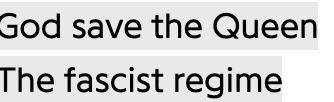
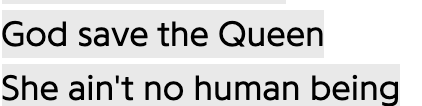
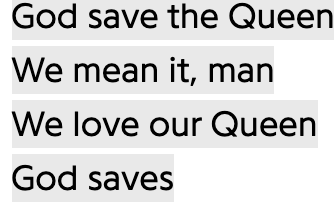

Putting these lyrics side by side, you can see the difference in them. The chorus may look like it is being nice to the Queen, however it is sarcasm. These lyrics from the Sex Pistols sparked controversy. Using reception theory, there is a. split with these lyrics, as there are people, usually the older generation and the upper class, that because of their political beliefs disagreed with the song, therefore they take the “oppositional reading” approach. As seen in the video of the Sex Pistols gig above, there are people who like the Sex Pistols and agree with the message they are putting across, so that portion of people take the “preferred reading” approach.
Bibliography
Tagg , Philip. E:\M55\COURSES\SEMIO\Semiotug.fm Introductory Notes to the Semiotics of Music. 2012.
Revision World. “Reception Theory – Media Studies – Revision World.” Revisionworld.com, 2019, revisionworld.com/a2-level-level-revision/media-studies-level-revision/reception-theory. Accessed 19 Mar. 2024.
Sign Salad. “What Is Semiotics?” SignSalad, SignSalad, 3 Jan. 2016, signsalad.com/our-thoughts/what-is-semiotics/. Accessed 19 Mar. 2024.
Wide, Steve. A Field Guide to Punk. Melbourne, Victoria, Smith Street Books, 2020.
Worley, Matthew. “Punk – Museum of Youth Culture.” Museum of Youth Culture, 3 Dec. 2019, www.museumofyouthculture.com/punk/. Accessed 20 Mar. 2024.
The Royal Household. “The Platinum Jubilee Weekend .” Www.royal.uk, 2022, www.royal.uk/platinum-jubilee-weekend#:~:text=The%20celebration%20saw%20famous%20faces,5%2C000%20tickets%20for%20key%20workers. Accessed 8 Apr. 2024.
Savage, Jon. “The Sex Pistols’ Jubilee Boat Trip – a Classic Account.” The Guardian, 29 May 2012, www.theguardian.com/music/2012/may/29/sex-pistols-jubilee-boat-trip. Accessed 16 Apr. 2024.
Jonathan L. Friedmann. “The Semiotics of Music.” THINKING on MUSIC, 6 June 2017, thinkingonmusic.wordpress.com/2017/06/06/the-semiotics-of-music/. Accessed 16 Apr. 2024.
Koenig, Alex, and Curumno. “God Save the Queen.” Genius, 27 Oct. 1977, genius.com/Sex-pistols-god-save-the-queen-lyrics. Accessed 16 Apr. 2024.
Griffiths, George. “Chart Flashback 1977: The Sex Pistols’ God Save the Queen Misses out on Number 1.” Www.officialcharts.com, 1 June 2022, www.officialcharts.com/chart-news/official-chart-flashback-1977-the-sex-pistols-anti-monarchist-anthem-god-save-the-queen-misses-out-on-number-1-during-silver-jubilee-celebrations__36499/. Accessed 16 Apr. 2024.
Media Studies. “Stuart Hall’s Reception Theory | Encoding and Decoding Messages.” Media Studies, 1 Oct. 2020, media-studies.com/reception-theory/. Accessed 16 Apr. 2024.