
Distribution – There are different ways to distribute your music. One of the biggest websites to do it on is DistroKid. On this website you can choose where you want to release your music. The options are Spotify, Amazon Music, Deezer etc. Then you give the details of the music you are releasing, such as the title, genre, the album cover and all the kind of things you need to release a song. You also have to put a release date, and it will take a week or longer to release so it can’t be the next day. There is also an option to set a pre-order date if that is necessary. There is also other websites to use such as Amuse, CD Baby and Ditto Music. They do a very similar thing to what DistroKid does. DistroKid is $19.99 a year and you can release an unlimited number of tracks, for CD Baby there is no annual cost however it is $9.95 to release a single and $29 to release an album and with Amuse they only charge you a one time fee of 20% on the first six releases. I personally think DistroKid is the best distributing website as it has the most features and is well priced.
Licensing – The two main types of licensing are PPL and PRS. Both of these collect royalties and give them to the people that worked on the music. PPL gives the royalties to performers and record companies whereas PRS gives the royalties to songwriters, composers and publishers. These work by people who want to play music in a public place, so a bar, restaurant, hairdresser etc. They will have to pay for the PPL and PRS licenses, and they have to renew them each year. The price of these licenses changes for the specific business you are, so a cinema will have a different price to a restaurant, and a pub will have a different price to a gym. These licenses are good because it makes sure the artist and the people who working on their music actually get compensated for their work. Without these licences artists wouldn’t get the money they deserve and need, it is a really good way of giving the money to the people who deserve. Also PPL and PRS don’t take any money for themselves they give it all back to the artist. How to sign up for these two licenses is to either complete an application form or ring one of the team members up.
Music societies and unions – A big union that helps musicians is the Musicians Union. They are a group of people that help musicians across the world. They stand up for musicians by offering them legal help, and helping them get the money they deserve for their work. They currently have around 32,000 members. They also make sure they get work and the work is right for them. They also help everyone in music, they don’t just help artists, they help teachers, performers, song writers, orchestra, theater and recording and broadcasting. You can join the Musicians Union by registering online, it’s £1 for your first six months if you are a new member, then it is £227 per year if you want the full range of benefits. There is also the ISM, which is the Incorporated Society for Musicians. The ISM is based in the UK, and they have around 10,000 members, so it is smaller than the Musicians Union but still helps a lot of musicians. The ISM are also a non profit organisation just like the Musicians Union. To join the ISM it is £171 per year. They basically do the same thing as the Musician’s Union however they are UK based. Public liability insurance is insurance that covers you if somethings goes wrong, such as an injury or damage to property. In a musicians case, this is used if for example at a venue if the artists broke the stage or a member of the audience got injured, the cost of it would get covered.
Contracts and Invoices – This is an invoice I made using an invoice generator.
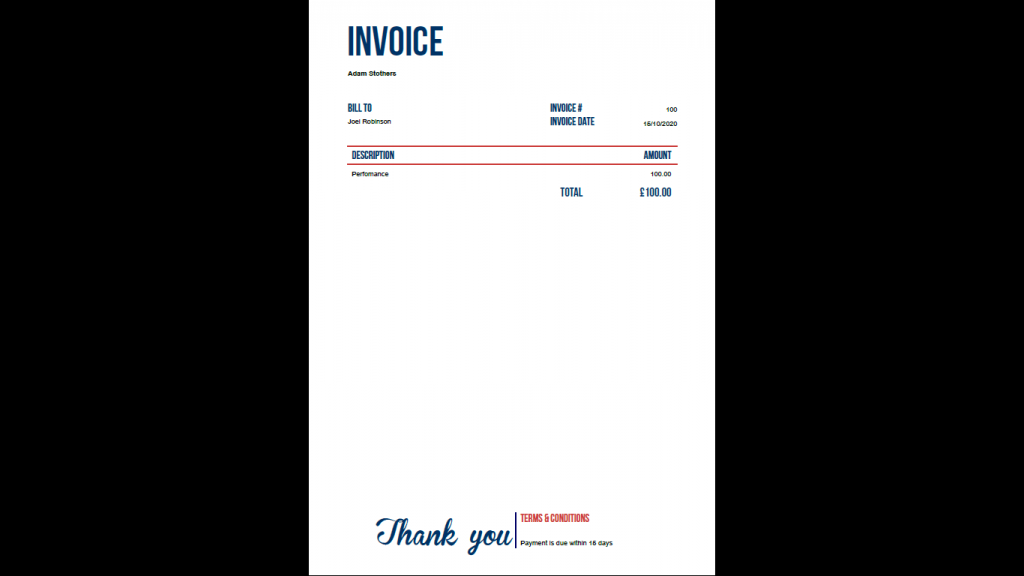
Musicians use invoices so that they can easily pay the artist or the venue. It is a quick, easy and safe way to bill a client. You would send an invoice to an artist, a venue or an agent. A work fire hire contract is a contract that the recording company will give to the artist.
This means that the work the artist does, so the music they make, belongs to the recording company. This means that the artist only get compensated for what they negotiated for. This can be a big issue if the single or the album blows up, it can then be a big issue as the artist a lot of the time will want more money as it is their work that is making the money, but as they have already signed the contract they can’t renegotiate it.